About 389 minutes
Routledge rides alone — Text and Context
Exploration Survival Adventure Tales
89,463 recorded words. 3 minutes difference from this book's estimate.
View Gutenberg source #73334
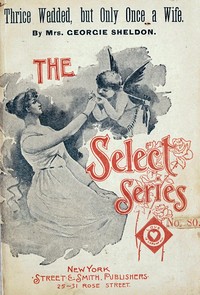
The source record for Thrice wedded, but only once a wife — Inside the Classic measures this digital text at 88,574 words, 6 hr 26 min estimated reading time, and 48 detected text sections.
The text analysis averages about 18.4 words per sentence, while the detected sections provide another way to judge how the source is divided.
Project Gutenberg metadata also associates the work with “Dime novels,” connecting these edition facts with the source record’s subject description.
Explore this collection
These alternatives are selected using recorded categories and estimated reading time.
About 389 minutes
Exploration Survival Adventure Tales
89,463 recorded words. 3 minutes difference from this book's estimate.
View Gutenberg source #73334About 373 minutes
Exploration Survival Adventure Tales
85,774 recorded words. 13 minutes difference from this book's estimate.
View Gutenberg source #69341About 341 minutes
Exploration Survival Adventure Tales
78,352 recorded words. 45 minutes difference from this book's estimate.
View Gutenberg source #72816Search stored excerpts and compare books → Choose by your preferences →
Choices use stored catalog measurements. Estimates vary with reading speed. A shared category is a catalog label, not a claim that two books have the same argument or literary quality.
Search reads excerpt text stored with this catalog and links to its associated Gutenberg record. The connection is stored in the site database; this tool does not recheck that every excerpt is word-for-word identical to that external record. Excerpt search does not cover every chapter and does not verify historical publication dates.
Catalog snapshot checked: 2026-09-26. Coverage: 100 public books, 100 available source excerpts.
Calculated from edition completeness, EPUB availability, text structure and catalogue metadata. Not a user rating.
Total of 100 points, scaled to a 2.5-5.0 range. Editions with an empty description or a missing EPUB file are not scored.
Public-domain source text
The source text is kept in the dedicated reader, separate from this catalogue record and its commentary.
From its opening pages, Thrice Wedded, but Only Once a Wife establishes a narrative voice that oscillates between clipped, exclamatory dialogue and extended passages of internal turmoil. The excerpt from Chapter XX shows the hero, Robert, pacing, striking his brow, and groaning aloud as he pieces together a conspiracy against him. The prose mirrors his agitation: sentences are broken by dashes, rhetorical questions, and repeated phrases like “Yes, yes” and “Oh, why does Heaven permit such wickedness?” This breathless style, typical of dime novels, keeps emotional temperature high and narrative momentum constant.
The narrator frequently reports physical reactions—Robert “started to his feet,” “paced back and forth,” “struck his hand violently against his brow,” “wrung his hands in his agony.” These gestures are not merely descriptive; they become a rhythmic cue for emotional peaks. The dialogue is peppered with exclamations (“How exceedingly strange!”) and self-accusations (“fool that I have been”). The heroine, Vivien, speaks in a more measured tone, but her calmness only heightens the contrast. This pattern of rapid alternation between outburst and composure suggests a deliberate pacing strategy: the reader is never allowed to settle.
The chapter introduces a story-within-a-story: Vivien begins to recount her mother’s romance in Italy, a tale that slows the immediate crisis. The shift from Robert’s frantic present to Vivien’s measured past creates a temporal lull. Her narrative uses longer, more flowing sentences (“She was the darling of their hearts, the light and pride of their eyes”) and a fairy-tale cadence. This structural change in pace—from staccato anxiety to lyrical exposition—gives the reader breathing room while hinting that the two stories will converge. The excerpt ends with Robert urging her to continue, signaling that the pace will soon quicken again.
Several details recur across the excerpt: the word “plot” appears three times; characters repeatedly ask for “confidence” or “trust”; and the hero’s illegitimacy is hinted at through the chief’s earlier disclosure. The setting of S——, Massachusetts, is named but left vague, a common dime-novel technique to suggest authenticity without specificity. The heroine’s small white hand and gentle eyes are described twice, reinforcing a visual motif of innocence that contrasts with Robert’s violent gestures. These repeated elements—secrecy, illegitimacy, a mysterious father—form the narrative’s emotional and structural backbone, driving the rapid shifts in pace.
Readers should attend to how Sheldon uses physical action as shorthand for emotion—a technique that keeps the story moving even when the plot relies on coincidences. The pacing is not uniform; it pulses between crisis and backstory. Noticing when the narrative slows (as in Vivien’s tale) can help anticipate the next revelation. The dime-novel format rewards quick reading, but the voice rewards attention to its deliberate rhythms.
I remember clutching a tattered paperback on a rainy porch, that same breathless ache of a heroine trapped by lies. It reminds me of the quiet rage in Apache devil — how identity, once stolen, becomes a cage you build yourself. Some stories just know that particular loneliness. Apache devil — Edition Insights gave me that feeling back.
Capture what you thought, learned, and would like to remember.