About 323 minutes
Apache devil — Edition Insights
Exploration Survival Adventure Tales
74,145 recorded words. 18 minutes difference from this book's estimate.
View Gutenberg source #70101
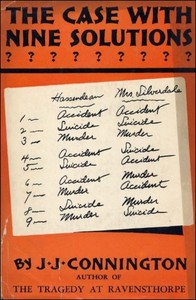
The source record for The case with nine solutions — Inside the Classic measures this digital text at 78,352 words, 5 hr 41 min estimated reading time, and 22 detected text sections.
The text analysis averages about 13.1 words per sentence, while the detected sections provide another way to judge how the source is divided.
Project Gutenberg metadata also associates the work with “Detective and mystery stories,” connecting these edition facts with the source record’s subject description.
Explore this collection
These alternatives are selected using recorded categories and estimated reading time.
About 323 minutes
Exploration Survival Adventure Tales
74,145 recorded words. 18 minutes difference from this book's estimate.
View Gutenberg source #70101About 373 minutes
Exploration Survival Adventure Tales
85,774 recorded words. 32 minutes difference from this book's estimate.
View Gutenberg source #69341About 300 minutes
Exploration Survival Adventure Tales
68,781 recorded words. 41 minutes difference from this book's estimate.
View Gutenberg source #69342Search stored excerpts and compare books → Choose by your preferences →
Choices use stored catalog measurements. Estimates vary with reading speed. A shared category is a catalog label, not a claim that two books have the same argument or literary quality.
Search reads excerpt text stored with this catalog and links to its associated Gutenberg record. The connection is stored in the site database; this tool does not recheck that every excerpt is word-for-word identical to that external record. Excerpt search does not cover every chapter and does not verify historical publication dates.
Catalog snapshot checked: 2026-09-26. Coverage: 100 public books, 100 available source excerpts.
Calculated from edition completeness, EPUB availability, text structure and catalogue metadata. Not a user rating.
Total of 100 points, scaled to a 2.5-5.0 range. Editions with an empty description or a missing EPUB file are not scored.
Public-domain source text
The source text is kept in the dedicated reader, separate from this catalogue record and its commentary.
The first chapter introduces Dr. Ringwood returning home late, visibly over-tired, to a fog so thick that even the nearest street lamp is invisible. The domestic setting—a study with a bright fire, saddlebag armchairs, and a copy of the B.M.J.—is rendered with precise, almost tactile detail. The fog is not merely atmospheric; it becomes a practical obstacle, as Ringwood worries about night calls and his servant Shenstone offers to accompany him. This opening establishes a world where physical conditions directly shape action, a pattern that recurs throughout the excerpts.
By the second excerpt, the narrative has moved to a formal investigation. Sir Clinton Driffield, the Chief Constable, discusses toxicology with Dr. Markfield, focusing on the exact dosage of hyoscine administered. The language shifts from weary domesticity to clinical precision: “twelve times the normal dose,” “ten milligrammes or even slightly over.” The contrast between the fog-bound opening and the sterile interview room signals the book’s dual nature—part atmospheric thriller, part puzzle.
The fog in the opening chapter is not merely a backdrop; it functions as a narrative constraint. Dr. Ringwood’s exhaustion and the pea-soup fog combine to create a sense of isolation and vulnerability. Shenstone’s offer to accompany him on night calls—and Ringwood’s skeptical reply, “Doubtful if you can see any further through pea-soup than I can myself”—underscores the limits of human perception in this world. The fog reappears implicitly in later excerpts: the investigation proceeds through interviews and evidence, not direct observation. The reader, like the characters, must piece together events that occurred in obscurity.
This structural use of fog aligns with the book’s title, which promises multiple solutions. The fog literalizes the difficulty of seeing clearly, preparing the reader for a mystery where the truth is obscured by competing interpretations. Connington does not overplay the metaphor; instead, he lets the physical detail do the work.
Connington’s prose is notably clinical, especially in descriptions of people. When Inspector Flamborough first sees Norma Hailsham, he notes her “scrupulous neatness,” her “squarish chin,” and her “long thin-lipped flexible mouth.” His internal commentary— “She might flash up in a moment, but with that jaw and those lips she wouldn’t cool down again in a hurry”—reads like a diagnostic report. This observational style extends to the investigation itself: Sir Clinton and Dr. Markfield discuss hyoscine dosages with the precision of a post-mortem.
The effect is to make characters seem like specimens under a microscope. Even Sir Clinton’s courtesy is strategic: he maneuvers Norma into the light so Flamborough can study her face. The reader is invited to observe the observers, noting how their professional habits shape their judgments. This self-awareness distinguishes Connington’s detective fiction from simpler puzzle plots.
The title The Case with Nine Solutions is echoed in the chapter list, which includes “VI. The Nine Possible Solutions.” The excerpts do not reveal what those solutions are, but they establish the investigative framework. Sir Clinton and Dr. Markfield’s discussion of hyoscine dosage is a microcosm of the larger puzzle: they debate whether the exact amount was 12 or 15 times the normal dose, acknowledging that Markfield’s figure is a “rough” minimum. This attention to margin of error suggests a mystery built on fine distinctions.
The presence of multiple solutions implies that the case will be solved not by a single revelation but by eliminating alternatives. The reader is encouraged to track evidence as carefully as the characters do. The excerpts hint at a complex web: the Hassendean business, a code advertisement, a journal, and wills. Each clue may support more than one interpretation, and the final solution will depend on weighing probabilities.
Connington employs a third-person narrative that shifts focalization. The opening chapter stays close to Dr. Ringwood’s tired perspective, but later excerpts adopt the viewpoint of Inspector Flamborough, who observes Sir Clinton observing Norma Hailsham. This layered observation creates a sense of narrative distance: the reader is always aware that characters are being watched and judged.
The dialogue is functional and often expository, as when Sir Clinton and Dr. Markfield discuss the poison. Yet there are moments of dry humor, as in Ringwood’s comment about the fog. The prose avoids florid description; even the fog is described in practical terms. This restraint suits a detective story that prioritizes logic over atmosphere. The narrative voice is that of a reliable but detached reporter, letting the evidence speak for itself.
Readers approaching The Case with Nine Solutions for the first time should attend to the physical details—fog, lighting, posture—that Connington uses to convey mood and motive. The excerpts suggest a mystery that rewards careful reading of both dialogue and description. The nine solutions of the title are not a gimmick but a structural promise: the story will present multiple plausible explanations, each grounded in the evidence. The challenge is to see which one holds up under scrutiny.
The rain kept the house quiet that Tuesday, so I lingered over the poisoned glass and Sir Clinton's measured patience. There's a comfort in orderly minds sorting chaos. That mood carried me later to Winona — Text and Context, where another kind of scrutiny waits—less about who did it, more about how a life gets shaped. Both left me feeling the weight of details.
Answer a few questions and save a private reflection on this device.