About 58 minutes
The prior claim — A Reader’s Guide
Exploration Survival Adventure Tales
13,216 recorded words. 21 minutes difference from this book's estimate.
View Gutenberg source #71775
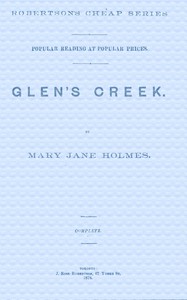
Before opening Glen's Creek — Reading Companion, the edition data offers a quick orientation: 18,060 words, 1 hr 19 min estimated reading time, and 15 detected text sections.
The text analysis averages about 24.8 words per sentence, while the detected sections provide another way to judge how the source is divided.
Project Gutenberg metadata also associates the work with “Frontier and pioneer life -- Kentucky -- Fiction,” connecting these edition facts with the source record’s subject description.
Explore this collection
These alternatives are selected using recorded categories and estimated reading time.
About 58 minutes
Exploration Survival Adventure Tales
13,216 recorded words. 21 minutes difference from this book's estimate.
View Gutenberg source #71775About 100 minutes
Exploration Survival Adventure Tales
22,806 recorded words. 21 minutes difference from this book's estimate.
View Gutenberg source #75172About 207 minutes
Exploration Survival Adventure Tales
47,386 recorded words. 128 minutes difference from this book's estimate.
View Gutenberg source #74435Search stored excerpts and compare books → Choose by your preferences →
Choices use stored catalog measurements. Estimates vary with reading speed. A shared category is a catalog label, not a claim that two books have the same argument or literary quality.
Search reads excerpt text stored with this catalog and links to its associated Gutenberg record. The connection is stored in the site database; this tool does not recheck that every excerpt is word-for-word identical to that external record. Excerpt search does not cover every chapter and does not verify historical publication dates.
Catalog snapshot checked: 2026-09-26. Coverage: 100 public books, 100 available source excerpts.
Calculated from edition completeness, EPUB availability, text structure and catalogue metadata. Not a user rating.
Total of 100 points, scaled to a 2.5-5.0 range. Editions with an empty description or a missing EPUB file are not scored.
Public-domain source text
The source text is kept in the dedicated reader, separate from this catalogue record and its commentary.
The opening chapter of Glen's Creek establishes a Kentucky landscape that is both idyllic and haunted: a brick church, a schoolhouse, and graves lie under forest trees, while the narrator notes that the story concerns a time “near the commencement of the nineteenth century,” when the region was “one entire forest” dotted with log huts. The catalog subjects—frontier and pioneer life, Kentucky history—are clearly present, but the excerpts also reveal a strong focus on cross-cultural encounter and racial anxiety. The narrative voice is direct and occasionally intrusive, as when it warns the reader about the character Orianna: “think not that Robert Hunting will ever wed an Indian.”
The novel’s first paragraph is a long, rhythmic sentence that moves from Lake Erie through Ohio into Kentucky, ending at “the shady hillside, bright green valley, and dancing waterbrook, known as Glen’s Creek.” This is not mere scene-setting: the description includes a church “consecrated to the worship of God” where “bond and free” congregate, and a schoolhouse where “Yankee schoolmasters” have used “moral suasion, hickory sticks and leathern straps.” The narrator then contrasts this settled scene with the earlier era when “the Indian warrior sought shelter” under the same trees. The landscape thus becomes a palimpsest of past and present, indigenous and settler, and the text signals that the story will explore these layers.
A central thread in the excerpts is the Native American girl Orianna’s longing to be white. When she bathes her face at midnight, hoping to “wash off the offensive colour,” and prays to “the white man’s God” to “make Orianna white,” the narrative dramatizes a painful internalization of racial hierarchy. Earlier, Robert Hunting tells her “why were you not white!” and Marian warns him not to “raise hopes which you know can never be realized.” The text does not endorse Orianna’s wish—the narrator’s aside about Robert being “no Rolfe, and you no Pocahontas” distances the story from romanticized interracial union—but it gives her desire sustained attention, making race a visible, troubled theme.
Holmes’s narrator frequently steps forward to comment on the action or address the reader directly. When Marian fears Orianna’s gaze, the narrator reassures: “fear not, young Marian, for though she strokes your silken curls … the forest maiden will do you no harm.” Later, after Orianna’s midnight prayer, the narrator breaks off with “but a [...]” (the excerpt is cut). This technique creates an intimate, sometimes moralizing tone, and it shapes how the frontier setting is mediated. The catalog subject “frontier and pioneer life” is thus filtered through a narrator who interprets events for the reader, rather than simply reporting them.
The excerpts offer a partial view: they establish setting, introduce key characters (Marian, Robert, Charlie, Orianna, Narretta), and foreground racial tension, but the plot’s full arc—including the hinted romance and Orianna’s fate—remains unknown. Readers should attend to how the narrator’s interventions guide sympathy and judgment, and to the tension between the pastoral opening and the uneasy encounters that follow.
I’ve long kept Glen’s Creek close, especially those quiet passages where Orianna yearns to shed her own skin. It reminds me of another shelf-mate, Troubled Waters — A Reader’s Guide, which circles similar currents of longing and belonging. They sit together now, two old friends sharing a slow, knowing glance across the stacks.
Capture what you thought, learned, and would like to remember.