About 386 minutes
Thrice wedded, but only once a wife — Inside the Classic
Exploration Survival Adventure Tales
88,574 recorded words. 13 minutes difference from this book's estimate.
View Gutenberg source #70837
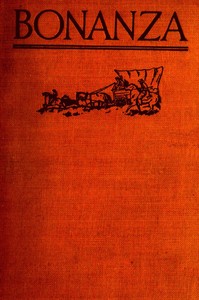
This digital edition of Bonanza: A story of the Gold Trail — Inside the Classic is described by source-level measurements including 85,774 words, 6 hr 13 min estimated reading time, and 11 detected text sections.
The text analysis averages about 12.2 words per sentence, while the detected sections provide another way to judge how the source is divided.
Project Gutenberg metadata also associates the work with “Western stories,” connecting these edition facts with the source record’s subject description.
Explore this collection
These alternatives are selected using recorded categories and estimated reading time.
About 386 minutes
Exploration Survival Adventure Tales
88,574 recorded words. 13 minutes difference from this book's estimate.
View Gutenberg source #70837About 389 minutes
Exploration Survival Adventure Tales
89,463 recorded words. 16 minutes difference from this book's estimate.
View Gutenberg source #73334About 341 minutes
Exploration Survival Adventure Tales
78,352 recorded words. 32 minutes difference from this book's estimate.
View Gutenberg source #72816Search stored excerpts and compare books → Choose by your preferences →
Choices use stored catalog measurements. Estimates vary with reading speed. A shared category is a catalog label, not a claim that two books have the same argument or literary quality.
Search reads excerpt text stored with this catalog and links to its associated Gutenberg record. The connection is stored in the site database; this tool does not recheck that every excerpt is word-for-word identical to that external record. Excerpt search does not cover every chapter and does not verify historical publication dates.
Catalog snapshot checked: 2026-09-26. Coverage: 100 public books, 100 available source excerpts.
Calculated from edition completeness, EPUB availability, text structure and catalogue metadata. Not a user rating.
Total of 100 points, scaled to a 2.5-5.0 range. Editions with an empty description or a missing EPUB file are not scored.
Public-domain source text
The source text is kept in the dedicated reader, separate from this catalogue record and its commentary.
The opening chapter thrusts readers into the desert with a Pony Express rider, establishing a world of sage, adobe stations, and wiry men in high-heeled boots. The catalog subjects—Western stories and gold mining—are immediately visible, but the excerpts reveal a narrative more concerned with character interplay than with mining itself. The title Bonanza promises a strike, yet the text dwells on the McClintock brothers' decisions and the threat posed by Ralph Dodson, a man Hugh distrusts from their first meeting. The novel's voice shifts between action and interior worry, as when Hugh imagines Vicky moving 'like sweet music toward the open arms of Dodson.' This note traces how the excerpts balance the promised gold-rush adventure with a quieter, anxious thread about personal risk.
The first chapter introduces the Pony Express rider through a static, almost tableau-like description: a man waits, a horse is held, the desert stretches 'far as the eye could see.' The rider Byers is 'small and wiry, hard as nails,' his gear detailed with precision. This opening does not rush into action but instead establishes a figure of endurance. The catalog subject 'Exploration, Survival & Adventure Tales' fits, yet the excerpt focuses on the rider's stillness and the landscape's flatness. The narrative voice here is economical, using concrete nouns—sage, adobe, chestnut horse—to build a sense of place. Later, when Hugh McClintock decides to travel by stage over the Geiger Grade, the Pony Express motif fades, but the initial image lingers as a benchmark of the frontier's demands. The excerpts suggest that the novel uses the Express not as a central plot device but as a symbol of the speed and danger that frame the characters' choices.
The excerpts from chapters XXI and beyond shift to the Ground Hog mine and the claim staked for Vicky Lowell. Budd's letters are filled with optimism—'we're sure right close to the vein'—but Hugh discounts this, having heard such predictions before. The mining activity is reported secondhand, through messages and gossip, rather than shown directly. What emerges instead is Hugh's growing unease about Ralph Dodson's attentions to Vicky. The narrative voice turns inward: Hugh 'profoundly distrusted' Dodson, seeing him as a 'ravening wolf.' The claim itself becomes a pretext for Hugh's journey to Piodie, and the excerpts leave the mine's success unresolved. The catalog subject 'Gold mines and mining — Fiction' is present, but the text prioritizes the emotional stakes over the mineral ones. The reader is left with a sense that the real bonanza may be personal rather than geological.
The excerpts reveal a narrator who moves between blunt action and lyrical anxiety. When Hugh imagines Vicky's face 'finely cut like a rare brilliant, full of fire and high lights,' the prose becomes almost poetic. Yet the same chapter includes Budd's colloquial warning: 'if I was a high-stepping colt like you, I’ll be doggoned if I’d let that smooth guy Dodson jump as rich a prospect as the Little Schoolmarm.' This mix of registers—elevated and vernacular—characterizes the novel's style. However, the excerpts are incomplete; they do not show the resolution of the blizzard, the fate of the mine, or Vicky's own perspective. The catalog subjects suggest a straightforward Western, but the text hints at a more psychological narrative. Readers should note that the excerpts end mid-scene, with Hugh traveling through snow, and the novel's full arc remains unknown from these passages alone.
Readers approaching Bonanza through these excerpts should attend to the tension between the promised gold-rush action and the quieter, character-driven conflicts that emerge. The novel's interest in interior states—Hugh's worries, Budd's enthusiasm, the unspoken threat of Dodson—complicates the catalog's simple 'Western stories' label. The excerpts offer a glimpse of a narrative that values emotional stakes as much as physical adventure, though the full story of the strike and the characters' fates remains to be discovered.
That rainy afternoon, Bonanza kept me company while the windows blurred. I remember lingering over a quiet scene between two miners, the weight of unspoken loyalty settling like damp air. After closing it, something nudged me toward Perch of the Devil — Inside the Classic, and I found the same stubborn kindness in different clothes. Rain pooled on the sill; I kept reading.
Capture what you thought, learned, and would like to remember.