About 648 minutes
Nineteen hundred? A forecast and a story — Context and Discussion
Exploration Survival Adventure Tales
148,996 recorded words. 0 minutes difference from this book's estimate.
View Gutenberg source #69638
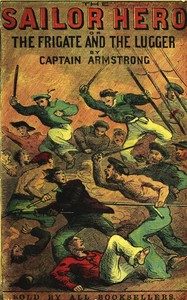
The catalog record for The sailor hero — Text and Context provides practical reading context through 149,025 words, 10 hr 48 min estimated reading time, and 50 detected text sections.
The text analysis averages about 23.4 words per sentence, while the detected sections provide another way to judge how the source is divided.
Project Gutenberg metadata also associates the work with “Great Britain. Royal Navy -- Fiction,” connecting these edition facts with the source record’s subject description.
Explore this collection
These alternatives are selected using recorded categories and estimated reading time.
About 648 minutes
Exploration Survival Adventure Tales
148,996 recorded words. 0 minutes difference from this book's estimate.
View Gutenberg source #69638About 602 minutes
Exploration Survival Adventure Tales
138,328 recorded words. 46 minutes difference from this book's estimate.
View Gutenberg source #69429About 571 minutes
Exploration Survival Adventure Tales
131,121 recorded words. 77 minutes difference from this book's estimate.
View Gutenberg source #70446Search stored excerpts and compare books → Choose by your preferences →
Choices use stored catalog measurements. Estimates vary with reading speed. A shared category is a catalog label, not a claim that two books have the same argument or literary quality.
Search reads excerpt text stored with this catalog and links to its associated Gutenberg record. The connection is stored in the site database; this tool does not recheck that every excerpt is word-for-word identical to that external record. Excerpt search does not cover every chapter and does not verify historical publication dates.
Catalog snapshot checked: 2026-09-26. Coverage: 100 public books, 100 available source excerpts.
Calculated from edition completeness, EPUB availability, text structure and catalogue metadata. Not a user rating.
Total of 100 points, scaled to a 2.5-5.0 range. Editions with an empty description or a missing EPUB file are not scored.
Public-domain source text
The source text is kept in the dedicated reader, separate from this catalogue record and its commentary.
F.C. Armstrong's The Sailor Hero; or The Frigate and the Lugger (1875) is cataloged under Great Britain. Royal Navy -- Fiction and First Coalition, War of the, 1792-1797 -- Fiction. Yet the excerpts open not with a battle but with a schoolboy grudge: Henry Howard Etherton resents William Thornton for excelling him “in mental acquirements, and bodily exercises.” The war with France is announced in the first sentence, but the immediate conflict is social—Etherton spreads rumors about Thornton’s low birth as the son of Lord Hood’s coxswain. The catalog subjects suggest a straightforward naval yarn; the text, however, foregrounds class anxiety and personal enmity within the service.
The excerpts reveal that William Thornton’s heroism is initially a matter of reputation rather than deed. He is “the Admiral’s protégé,” a “general favourite,” and has “distinguished himself on several occasions,” but the reader is not shown these exploits. Instead, the narrative dwells on the mystery of his parentage: his “supposed father” was a coxswain, and someone paid for his schooling “munificently.” Etherton’s malice hinges on this ambiguity, calling Thornton of “so doubtful, or at all events, of so low an origin.” The catalog subject of Royal Navy fiction might imply a focus on duty and combat, but the excerpts prioritize a hero whose worth is questioned by his peers, not by the enemy. The war setting provides a backdrop for personal vindication rather than national conflict.
Later excerpts introduce a French dimension that the catalog subjects only partially capture. Lieutenant Thornton converses with Jean Plessis about a casket robbed during the evacuation of Toulon—a historical event within the War of the First Coalition. The thief is a former galley-slave who “made himself notorious after the evacuation, by his bloodthirsty revenge upon all aristocrats.” This plot thread involves Mademoiselle de Tourville, an orphan fleeing France with “a horror of France, from what she witnessed and suffered.” The catalog subjects list the war but not the refugee experience or the novel’s interest in Revolutionary violence. The excerpts show that the war is not just a setting for naval action but a source of civilian displacement and intrigue, complicating the simple adventure label.
The excerpts demonstrate a distinctive voice in the character of Captain Patrick O’Loughlin, who insists on informality: “if you sir me when in private, I must put you under arrest for mutiny.” His banter with Lieutenant Charles Pole, who calls Thornton “Sir Oscar,” reveals a warm, Irish-accented camaraderie that contrasts with the earlier tension. The narrative shifts between formal exposition and colloquial dialogue, as when O’Loughlin declares himself “a rank revolutionist” while drinking to the hero. This tonal variety suggests that the novel balances melodrama with humor, a feature not evident from the catalog subjects alone. The excerpts also show that Thornton is often referred to by his title, indicating a rise in status that the opening chapters only hint at.
Readers approaching The Sailor Hero expecting a continuous sea chase will find instead a novel that weaves personal vendetta, class prejudice, and Revolutionary backstory into its naval framework. The excerpts suggest that Armstrong uses the war as a stage for character-driven conflicts, with the frigate and lugger of the title perhaps symbolizing opposing forces within the hero’s own world. The incomplete excerpts leave the resolution of Thornton’s parentage and the fate of Mademoiselle de Tourville unclear, but the existing text rewards attention to its social dynamics and historical texture.
I found myself lingering over the Armstrong excerpts, those quiet class tensions beneath the naval bravado. It reminded me of another old puzzle, the sort where the real mystery isn’t the case itself but the people circling it. That same careful restraint lives in The case with nine solutions — Inside the Classic, and I smiled, thinking how some stories age less like history and more like a familiar room.
Answer a few questions and save a private reflection on this device.