About 491 minutes
The victory — A Reader’s Guide
Exploration Survival Adventure Tales
112,722 recorded words. 40 minutes difference from this book's estimate.
View Gutenberg source #72927
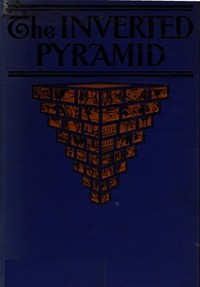
Before opening The inverted pyramid — Reading Companion, the edition data offers a quick orientation: 103,590 words, 7 hr 31 min estimated reading time, and 9 detected text sections.
The text analysis averages about 13.4 words per sentence, while the detected sections provide another way to judge how the source is divided.
Project Gutenberg metadata also associates the work with “British Columbia -- Fiction,” connecting these edition facts with the source record’s subject description.
Explore this collection
These alternatives are selected using recorded categories and estimated reading time.
About 491 minutes
Exploration Survival Adventure Tales
112,722 recorded words. 40 minutes difference from this book's estimate.
View Gutenberg source #72927About 389 minutes
Exploration Survival Adventure Tales
89,463 recorded words. 62 minutes difference from this book's estimate.
View Gutenberg source #73334About 386 minutes
Exploration Survival Adventure Tales
88,574 recorded words. 65 minutes difference from this book's estimate.
View Gutenberg source #70837Search stored excerpts and compare books → Choose by your preferences →
Choices use stored catalog measurements. Estimates vary with reading speed. A shared category is a catalog label, not a claim that two books have the same argument or literary quality.
Search reads excerpt text stored with this catalog and links to its associated Gutenberg record. The connection is stored in the site database; this tool does not recheck that every excerpt is word-for-word identical to that external record. Excerpt search does not cover every chapter and does not verify historical publication dates.
Catalog snapshot checked: 2026-09-26. Coverage: 100 public books, 100 available source excerpts.
Calculated from edition completeness, EPUB availability, text structure and catalogue metadata. Not a user rating.
Total of 100 points, scaled to a 2.5-5.0 range. Editions with an empty description or a missing EPUB file are not scored.
Public-domain source text
The source text is kept in the dedicated reader, separate from this catalogue record and its commentary.
The novel opens with an inventory: 'Item: one boy aged eighteen, name Roderick Norquay; one girl aged fifteen, named Mary Thorn; one gaudy cedar dugout canoe…' This catalog style, reminiscent of a ship's manifest, immediately establishes a tone of precise observation. Sinclair then shifts into a lyrical meditation on the Pacific coast's untold stories, contrasting the 'dull medium of admiralty charts' with the 'magic to the written word.' The narrative voice oscillates between this poetic yearning and a more detached, almost documentary register, as when Rod Norquay's tutor dismisses the lack of epic pioneer literature. This duality—between romantic aspiration and hard fact—shapes the early chapters.
Sinclair’s prose moves between two poles. In the opening, the narrator waxes rhapsodic about the 'swirling water' and 'invisible yet pulsing spirit' of the land, directly channeling Rod’s wish for a Homer of the North Coast. Yet this elevated language is undercut by blunt, almost bureaucratic phrasing: 'Item: one boy…' The effect is a narrative that seems unsure whether it is a romantic epic or a factual report. Later, when Rod reads war news, the voice tightens: 'Page by page, column by column, they conned that incredible account, piecing it out by inference, filling the terrible gaps by vivid conjecture.' The sentences become shorter, more clipped, mirroring the urgency of the news. This shift in pace—from expansive description to staccato reportage—signals a turning point in the story’s mood.
The excerpts show a marked change in narrative tempo once the war enters. Earlier, Sinclair lingers on natural details and philosophical musings; Rod wonders why no poet has sung of the coast. But when the war news arrives, the prose accelerates. The description of Rod and Mary reading newspapers is fragmented: 'Phil's gone,' Rod broke a long silence. 'Says so here.' The dialogue becomes terse, and the narrative jumps from the camp to Vancouver with a single sentence: 'A day and a night on this slow-footed vessel brought them to Vancouver.' The pace of the writing mirrors the characters' dislocation. Sinclair also uses visual details—'roof signs twinkled,' 'chaste illumination upon richly polished mahogany'—to contrast the old world of nature with the new world of commerce and conflict. The sign 'THE NORQUAY TRUST' offends Rod instinctively, a hint of personal tension woven into the historical shift.
Sinclair employs a few recurring devices that reward attention. The catalog style returns in the war section: 'Liége, Louvain, Charleroi, Mons, Cambrai, Namur'—a list of place names that echoes the initial inventory of characters and canoe. This structural repetition suggests a world reduced to items and locations. Another motif is the contrast between the 'benign face' of the inlet and the 'ferment' of the city. Rod’s reaction to the Norquay Trust sign—'his lip curled'—is described twice, emphasizing a visceral distaste that the narrative does not fully explain. These small, repeated gestures (the curl of the lip, the cataloging instinct) give the prose a texture that rewards close reading, even when the larger plot remains unclear from the excerpts alone.
Readers attuned to shifts in narrative voice will find Sinclair’s novel an interesting case of stylistic tension. The early chapters promise a lyrical regional epic, while the later excerpts suggest a more anxious, modern sensibility. Pay attention to how the prose handles transitions—between description and dialogue, between nature and city, between peace and war. The inverted pyramid of the title may refer not only to a social structure but to the narrative’s own shape: broad at the base of description, narrowing into the pointed urgency of historical events.
That rainy afternoon, The Inverted Pyramid kept shifting under my fingers—its calm, almost geological descriptions giving way to a tension I hadn’t expected, like weather turning. I paused on one of its catalog-like lists, names and places stacked like stones. Oddly, it reminded me of how marriages get inventoried too. Later, I found myself opening Thrice wedded, but only once a wife — Inside the Classic, and the same quiet reckoning was there.
Your answers remain private and are stored only in this browser.