About 291 minutes
All quiet on the Western Front — Themes and Context
Fantasy Juvenile Worlds
66,823 recorded words. 0 minutes difference from this book's estimate.
View Gutenberg source #75011
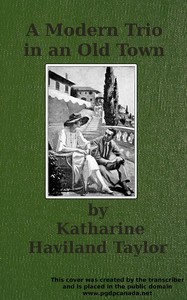
The catalog record for A modern trio in an old town — Reading Companion provides practical reading context through 66,781 words, 4 hr 51 min estimated reading time, and 28 detected text sections.
The text analysis averages about 21.9 words per sentence, while the detected sections provide another way to judge how the source is divided.
Project Gutenberg metadata also associates the work with “Young women -- Fiction,” connecting these edition facts with the source record’s subject description.
Explore this collection
These alternatives are selected using recorded categories and estimated reading time.
About 291 minutes
Fantasy Juvenile Worlds
66,823 recorded words. 0 minutes difference from this book's estimate.
View Gutenberg source #75011About 288 minutes
Fantasy Juvenile Worlds
66,129 recorded words. 3 minutes difference from this book's estimate.
View Gutenberg source #69185About 298 minutes
Fantasy Juvenile Worlds
68,426 recorded words. 7 minutes difference from this book's estimate.
View Gutenberg source #73740Search stored excerpts and compare books → Choose by your preferences →
Choices use stored catalog measurements. Estimates vary with reading speed. A shared category is a catalog label, not a claim that two books have the same argument or literary quality.
Search reads excerpt text stored with this catalog and links to its associated Gutenberg record. The connection is stored in the site database; this tool does not recheck that every excerpt is word-for-word identical to that external record. Excerpt search does not cover every chapter and does not verify historical publication dates.
Catalog snapshot checked: 2026-09-26. Coverage: 100 public books, 100 available source excerpts.
Calculated from edition completeness, EPUB availability, text structure and catalogue metadata. Not a user rating.
Total of 100 points, scaled to a 2.5-5.0 range. Editions with an empty description or a missing EPUB file are not scored.
Public-domain source text
The source text is kept in the dedicated reader, separate from this catalogue record and its commentary.
The narrator of A Modern Trio in an Old Town introduces herself as an eighteen-year-old prone to foolish apprehensions—a confession that immediately establishes a confiding, self-deprecating voice. The catalog subjects list young American women in Florence, and the excerpts confirm that the trio (the narrator, Viola, and presumably a third) navigate the city under the guidance of older expatriates like Mr. Wake. But the text does more than place characters in a setting: it uses the narrator’s observations to weave together social anxieties, art appreciation, and local color. Her description of a military band concert in Piazza Vittorio Emanuele, for instance, captures both the sensory excitement and the self-consciousness of a young American abroad.
The narrator’s tone is conversational and often humorous, as when she recalls dreading a party only to find it “fine” after a chair gets broken. This voice carries into the Florentine episodes: she describes the band concert with phrases like “deep, thick sense of enjoyment” and notes the Bersaglieri soldiers’ “always tilted, theatrical looking hats.” Yet she also reports Mr. Wake’s moralizing tale about Andrea del Sarto’s wife—a story that treats art history as a cautionary fable about materialism. The juxtaposition of the narrator’s teenage slang (“ghastly,” “delightful”) with such lectures suggests a Bildungsroman in which the trio absorbs both culture and life lessons. The excerpts do not reveal whether the narrator’s initial apprehensions prove foolish in Florence, but her reflective opening frames the entire narrative as a retrospective account of growing up.
The excerpts devote considerable space to a guided tour of Santissima Annunziata, where Mr. Wake points out Andrea del Sarto’s “Madonna of the Sack” and recounts the model’s story: a wife who “made him work like mad” for money and outlived him as a “shriveled hag.” This embedded lecture serves multiple purposes. It provides authentic Florentine detail (the Innocenti, the cloisters) while advancing a theme about the dangers of materialism—a theme that resonates with the trio’s own status as modern, moneyed Americans. Viola’s retort that her father is “stimulated by my need for pretty things” introduces a generational or cultural tension that the novel likely explores further. The narrator’s own reaction—she loses interest in the church after the story—shows her more engaged by human drama than by art for art’s sake. The excerpts do not reveal how this lesson affects the trio’s later choices.
Beyond the art tour, the excerpts hint at a broader social world. The chapter titles mention characters like Miss Parrish, Miss Harris-Clarke, Sam Deane, and a “Lady Santa Claus,” while the illustrations depict scenes of flirtation (Mr. Hemmingway kissing Miss Meek). The narrator’s voice remains central, but the presence of multiple adults suggests a comedy of manners among Americans in Florence. The catalog subject “Americans — Italy — Fiction” is borne out by the trio’s interactions with locals (waiters, soldiers) and fellow expats. The excerpts do not clarify the romantic plot, but the frontispiece caption—“Didn’t exaggerate, did I?”—implies a moment of self-awareness or apology. Readers can expect a light, observant narrative that balances sightseeing with social dynamics, all filtered through a narrator who is learning to distinguish genuine feeling from mere apprehension.
The excerpts offer a clear sense of the narrator’s voice and the Florentine setting, but they leave the trio’s individual arcs and the romantic entanglements largely implicit. Readers should attend to how the narrator’s retrospective framing shapes the telling—her opening admission of foolish fears may color every subsequent event. The novel’s structure, with chapter titles like “Dark Clouds” and “A Patch of Blue Sky,” suggests a patterned emotional journey. Approach the text as a period piece that uses its Italian backdrop to test the values of its young American characters.
Sometimes, reading A Modern Trio, I felt like I was wandering Florence at dusk, half-listening, half-watching the girls fumble toward their own becoming. It reminded me, in its gentleness, of how Among the gnomes — Reading Notes leaves a similar hush—things observed, not solved. Both are quieter pleasures, slipping away before you quite name them. That’s all. A warmth that lingers without asking for anything.
Save your reaction, strongest insight, and memorable passage.