About 156 minutes
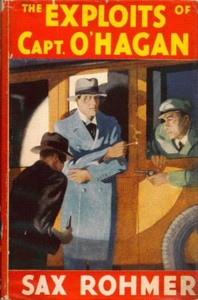
The exploits of Captain O'Hagan — Background and Themes
Fantasy Juvenile Worlds
35,803 recorded words. 6 minutes difference from this book's estimate.
View Gutenberg source #69544
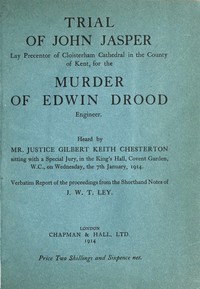
The catalog record for Trial of John Jasper, lay precentor of Cloisterham Cathedral in the County of Kent, for the murder of Edwin Drood, engineer — Edition Insights provides practical reading context through 34,345 words, 2 hr 30 min estimated reading time, and 11 detected text sections.
The text analysis averages about 13.1 words per sentence, while the detected sections provide another way to judge how the source is divided.
Project Gutenberg metadata also associates the work with “Trials (Murder) -- Fiction,” connecting these edition facts with the source record’s subject description.
Explore this collection
These alternatives are selected using recorded categories and estimated reading time.
About 156 minutes
Fantasy Juvenile Worlds
35,803 recorded words. 6 minutes difference from this book's estimate.
View Gutenberg source #69544About 170 minutes
Fantasy Juvenile Worlds
38,940 recorded words. 20 minutes difference from this book's estimate.
View Gutenberg source #71674About 118 minutes
Fantasy Juvenile Worlds
27,019 recorded words. 32 minutes difference from this book's estimate.
View Gutenberg source #69427Search stored excerpts and compare books → Choose by your preferences →
Choices use stored catalog measurements. Estimates vary with reading speed. A shared category is a catalog label, not a claim that two books have the same argument or literary quality.
Search reads excerpt text stored with this catalog and links to its associated Gutenberg record. The connection is stored in the site database; this tool does not recheck that every excerpt is word-for-word identical to that external record. Excerpt search does not cover every chapter and does not verify historical publication dates.
Catalog snapshot checked: 2026-09-26. Coverage: 100 public books, 100 available source excerpts.
Calculated from edition completeness, EPUB availability, text structure and catalogue metadata. Not a user rating.
Total of 100 points, scaled to a 2.5-5.0 range. Editions with an empty description or a missing EPUB file are not scored.
Public-domain source text
The source text is kept in the dedicated reader, separate from this catalogue record and its commentary.
This volume records a mock trial staged by the Dickens Fellowship on January 7, 1914, in which John Jasper, the lay precentor from Charles Dickens's unfinished novel The Mystery of Edwin Drood, is tried for the murder of his nephew. The event was held at King's Hall, Covent Garden, with G. K. Chesterton serving as judge and a jury that included George Bernard Shaw, Hilaire Belloc, and W. W. Jacobs. The transcript, taken from shorthand notes by J. W. T. Ley, presents the proceedings as a real courtroom drama, complete with indictment, witness examinations, and legal arguments.
Rather than a conventional literary analysis, this work is a hybrid of performance, legal satire, and fan speculation. The catalog subjects list it as fiction under 'Trials (Murder)' and as a work about Dickens's novel, but the text itself is a nonfictional record of a staged event. This editorial note examines how the mock trial format interacts with the unfinished mystery, the participants' roles, and the limits of what the transcript reveals about the original novel.
The transcript is neither a straightforward work of fiction nor a scholarly essay. It is a verbatim report of a theatrical event, complete with stage directions like 'The Court accordingly adjourned.' The participants are real people: Chesterton as judge, J. Cuming Walters as prosecutor, Cecil Chesterton as defense counsel, and actors such as Bransby Williams playing Durdles. The jury list reads like a who's who of Edwardian letters, including Shaw, Belloc, and Max Pemberton.
This hybridity means the text operates on multiple levels. It is a performance of a trial, a debate about Dickens's intentions, and a social gathering of literary figures. The catalog subject 'Trials (Murder) — Fiction' is technically accurate, but the work is not a novel; it is a dramatized legal proceeding. Readers expecting a narrative will find instead a script-like structure of testimony and argument, with gaps where the original novel's plot is assumed known.
The excerpts show the defense, led by Mr. Crotch, conceding that Jasper desired and attempted to murder Edwin Drood, but arguing that no murder occurred because the body was never found. Crotch states: 'We have every reason to believe that Edwin Drood is still alive.' This is a direct engagement with the central mystery of Dickens's unfinished novel: did Jasper actually kill Drood, or did Drood escape?
The defense attributes Jasper's failure to his opium addiction, using an anecdote about an Irish priest to argue that 'the drink' (or opium) caused both the attempt and its failure. This is a specific interpretation of the novel's clues, but the transcript does not provide evidence from the novel itself. The prosecution objects that this line of argument violates prior agreements, suggesting the mock trial had rules about how closely to adhere to Dickens's text. The excerpts thus reveal a tension between legal theater and literary fidelity.
G. K. Chesterton, as judge, interjects only briefly in the excerpts, once to ask about the absence of a body and once to adjourn the court. His role is largely procedural, but his presence as a famous writer and critic adds weight to the proceedings. The transcript does not include his verdict or any closing remarks, so the outcome of the trial is unknown from these excerpts.
The catalog subject 'Dickens, Charles, 1812-1870. Mystery of Edwin Drood' suggests the work is about Dickens's novel, but the transcript is a record of a performance, not a critical study. It does not analyze the novel's themes or characters; instead, it uses them as raw material for a legal game. Readers seeking insights into Dickens's intentions will find only indirect clues through the arguments of the participants. The work is best understood as a historical document of literary fandom in the early 20th century.
This mock trial transcript offers a unique window into how Edwardian literary figures engaged with an unfinished masterpiece. Rather than providing answers about Edwin Drood's fate, it dramatizes the very questions that have puzzled readers for decades. The work is best approached as a period piece of literary performance, where the line between scholarship and entertainment blurs. Readers familiar with Dickens's novel will recognize the characters and plot points, but the trial's value lies in its historical context and the playful seriousness of its participants.
I keep thinking about that Dickens Fellowship mock trial, how the evidence never quite settled into certainty. It lingered like a half-remembered dream, much as Odyssey of a hero — Text and Context did afterward—both asking what happens when a story refuses to conclude cleanly. There's something tender in that unfinishedness, isn't there? A quiet invitation to sit with the question a little longer.
A brief reflection can help important ideas stay with you longer.