About 304 minutes
Charles Dickens and other Victorians — Reading Companion
Fantasy Juvenile Worlds
69,905 recorded words. 4 minutes difference from this book's estimate.
View Gutenberg source #72466
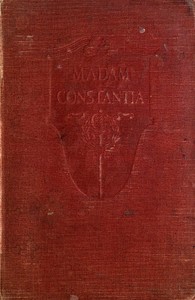
The source record for Madam Constantia — Background and Themes measures this digital text at 70,780 words, 5 hr 8 min estimated reading time, and 17 detected text sections.
The text analysis averages about 14.5 words per sentence, while the detected sections provide another way to judge how the source is divided.
Project Gutenberg metadata also associates the work with “United States -- History -- Revolution, 1775-1783 -- Fiction,” connecting these edition facts with the source record’s subject description.
Explore this collection
These alternatives are selected using recorded categories and estimated reading time.
About 304 minutes
Fantasy Juvenile Worlds
69,905 recorded words. 4 minutes difference from this book's estimate.
View Gutenberg source #72466About 298 minutes
Fantasy Juvenile Worlds
68,426 recorded words. 10 minutes difference from this book's estimate.
View Gutenberg source #73740About 291 minutes
Fantasy Juvenile Worlds
66,781 recorded words. 17 minutes difference from this book's estimate.
View Gutenberg source #69474Search stored excerpts and compare books → Choose by your preferences →
Choices use stored catalog measurements. Estimates vary with reading speed. A shared category is a catalog label, not a claim that two books have the same argument or literary quality.
Search reads excerpt text stored with this catalog and links to its associated Gutenberg record. The connection is stored in the site database; this tool does not recheck that every excerpt is word-for-word identical to that external record. Excerpt search does not cover every chapter and does not verify historical publication dates.
Catalog snapshot checked: 2026-09-26. Coverage: 100 public books, 100 available source excerpts.
Calculated from edition completeness, EPUB availability, text structure and catalogue metadata. Not a user rating.
Total of 100 points, scaled to a 2.5-5.0 range. Editions with an empty description or a missing EPUB file are not scored.
Public-domain source text
The source text is kept in the dedicated reader, separate from this catalogue record and its commentary.
Jefferson Carter's 'Madam Constantia' presents itself as an edited memoir, a choice that immediately shapes the reader's encounter with the text. The opening chapter, titled 'Sir Edward's Preface,' establishes a first-person narrator who is both participant and retrospective commentator. This framing device allows for a double perspective: the immediacy of events as they unfold and the reflective distance of a man writing years later. The editor's own preface acknowledges this ambiguity, noting that the narrative may owe 'something to the expansion of a man writing many years later.' Such a structure invites the reader to consider the reliability of memory and the shaping of personal history.
The narrator, Sir Edward Craven, speaks in a measured, observant tone that blends military precision with a sensibility attuned to atmosphere. His description of arriving at Winnsboro' camp contrasts the 'primitive cleanliness' and 'great spaces' of the Bluff with the 'close air and squalor of billets.' The diction is deliberate: 'lassitude and ennui' mark his return to routine, while the sights of 'scarlet of the King's uniform' and 'smart sentries' are rendered with a painterly eye. This voice is not merely reportorial; it conveys a character who is both a soldier and a man of reflection, one who finds the 'oaths and coarse talk' jarring after his recent experiences. The narrative's emotional register is thus established through specific, sensory details rather than broad declarations.
Dialogue in the excerpt reveals the formal codes of rank and courtesy within the British army. When Lord Rawdon greets Craven, his words are cordial yet maintain authority: 'My dear Craven, welcome back to life! Tarleton has done some good work, but he has never done His Majesty's cause a greater service than by restoring you to it.' The exchange is laced with deference—'my lord,' 'sir'—and the narrative notes the 'courteous insouciance' of Tarleton. These linguistic choices underscore a world where social standing and military hierarchy are constantly negotiated through speech. The editor's preface further complicates this by hinting at 'intimate passages' that may have been retained, suggesting that the dialogue serves not only plot but also character revelation.
The setting is rendered through concrete, physical details that ground the narrative in a specific time and place. The headquarters is 'a low white house, set back a little from the street and separated from it by a row of fine shade trees which sheltered a rough table and some benches.' Such descriptions avoid generic backdrop; they create a tangible environment. The mention of 'the Twenty-Third drilling in an open space with their queues and ribbons and powdered heads' evokes the visual culture of the 18th-century British army. These details are not merely decorative—they serve to contrast the order of the camp with the chaos of war, and to highlight the narrator's own shifting perceptions as he moves from the 'stillness' of the Bluff to the 'narrow bounds' of camp life.
The editorial apparatus—a preface, chapter headings, and a note on the manuscript's provenance—invites the reader to consider the text as a constructed artifact. The editor, Jefferson Carter, states that he has 'retained the fanciful title' and 'added some Chapter headings,' implying a light editorial touch. Yet the preface also raises questions about historical value and the expansion of memory. This framing creates a layered reading experience: one is simultaneously inside Sir Edward's story and outside it, aware of the mediating presence of the editor. The choice to present the narrative as an edited memoir rather than a straightforward novel allows for a nuanced exploration of truth, memory, and the personal cost of war.
Readers approaching 'Madam Constantia' should attend to the interplay between Sir Edward's immediate impressions and his later reflections. The narrative's power lies not in sweeping battle scenes but in the accumulation of precise, sensory observations and the subtle shifts in the protagonist's inner state. The editorial frame adds a layer of historical self-consciousness, reminding us that this is a story told and retold, shaped by time and perspective.
Create a short personal record of your experience with this book.