About 360 minutes
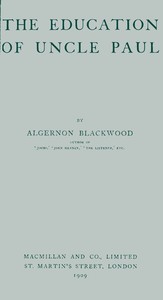
The education of Uncle Paul — Edition Insights
Fantasy Juvenile Worlds
82,602 recorded words. 69 minutes difference from this book's estimate.
View Gutenberg source #69668
This digital edition of Rogues and vagabonds — Background and Themes is described by source-level measurements including 98,650 words, 7 hr 9 min estimated reading time, and 29 detected text sections.
The text analysis averages about 16.6 words per sentence, while the detected sections provide another way to judge how the source is divided.
Project Gutenberg metadata also associates the work with “Families -- Fiction,” connecting these edition facts with the source record’s subject description.
Explore this collection
These alternatives are selected using recorded categories and estimated reading time.
About 360 minutes
Fantasy Juvenile Worlds
82,602 recorded words. 69 minutes difference from this book's estimate.
View Gutenberg source #69668About 346 minutes
Fantasy Juvenile Worlds
79,399 recorded words. 83 minutes difference from this book's estimate.
View Gutenberg source #72883About 308 minutes
Fantasy Juvenile Worlds
70,780 recorded words. 121 minutes difference from this book's estimate.
View Gutenberg source #70174Search stored excerpts and compare books → Choose by your preferences →
Choices use stored catalog measurements. Estimates vary with reading speed. A shared category is a catalog label, not a claim that two books have the same argument or literary quality.
Search reads excerpt text stored with this catalog and links to its associated Gutenberg record. The connection is stored in the site database; this tool does not recheck that every excerpt is word-for-word identical to that external record. Excerpt search does not cover every chapter and does not verify historical publication dates.
Catalog snapshot checked: 2026-09-26. Coverage: 100 public books, 100 available source excerpts.
Calculated from edition completeness, EPUB availability, text structure and catalogue metadata. Not a user rating.
Total of 100 points, scaled to a 2.5-5.0 range. Editions with an empty description or a missing EPUB file are not scored.
Public-domain source text
The source text is kept in the dedicated reader, separate from this catalogue record and its commentary.
The novel opens with an elaborate handbill for a fireworks display at Neptune's Grotto, a pleasure garden in Pimlico, dated July 20, 1829. The bill lists fifteen stages of pyrotechnics, culminating in a performer sliding down a 350-foot rope wreathed in Fizgigs and Fiery Serpents. This document is not merely decorative; it establishes the theatrical and precarious world the characters inhabit. The catalog subjects list Families and Theater as themes, and the excerpts bear this out: the story revolves around the Fuller family, whose members are entangled in stage life and its financial uncertainties.
The excerpts present a sharp contrast between two brothers: Bram, presumably a performer, and Caleb, a provincial businessman. In a tense scene, Nancy, Bram's wife, visits Caleb to discuss taking in Bram's child. Caleb's speech is laden with self-pity and financial excuses: he cannot afford a cat, let alone a child, and he is planning a marriage to a woman with no money. His language is sanctimonious—he winces at Nancy's directness and calls her stage talk "unpleasant." Nancy, by contrast, is blunt and practical. The dialogue reveals a family rift not just of circumstance but of worldview: Caleb values thrift and propriety, while Nancy embodies the frankness of the theatre. This tension between bohemian and bourgeois values runs through the excerpts.
The opening handbill is the most vivid evidence of the novel's theatrical setting. It specifies the order of firing, including "A Metamorphose with alternate changes" and "Chinese Lattice Work," and promises a "Grand Finale" by Mademoiselle Letizia Oriano. The name Letizia reappears as Nancy's daughter, suggesting a family legacy in performance. Later, Nancy carries a dressing-case, a prop that becomes a burden when she dismisses her fly and must wait for another. Small details like this—the dressing-case, the telephone call for a fly, the mention of a railway station—ground the story in the practical logistics of a touring performer's life. The novel does not romanticize the stage; it shows the mundane irritations behind the spectacle.
The pleasure garden Neptune's Grotto is described as one of many resorts that helped amuse Londoners "when the Londoner was comparatively a free man." The narrator notes that by 1829, most such gardens had been built over as Lord Grosvenor developed the Manor of Ebury. This historical observation links the characters' personal struggles to urban change: the world of open-air entertainments is being replaced by bricks and mortar. Similarly, Caleb's home in Brigham is described as having a smoky air, which he uses to discourage Nancy from leaving the child there. The setting is not backdrop but active commentary on class and progress. The novel uses place to underscore the precariousness of the theatrical profession against the encroaching respectability of suburban life.
Readers should attend to the novel's use of documents and objects—handbills, dressing-cases, telephones—as markers of character and era. The excerpts offer only fragments of the Fullers' story, but they suggest a work more interested in the friction between family obligation and artistic vocation than in plot mechanics. The title's "rogues and vagabonds" may refer to the performers themselves, but the excerpts hint that respectability can be its own kind of roguery.
Reading about that family’s tense vigil brought back a winter evening when my own grandmother fretted over a sick baby, the room thick with unspoken worry. I felt that same quiet hush inside Stonepastures — Inside the Classic, where a similar tenderness hides beneath plain words. Both books understand how love often speaks through small, fretful gestures.
Your answers remain private and are stored only in this browser.