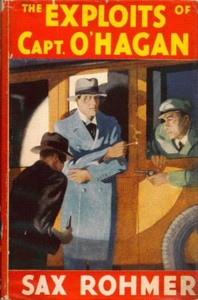
The exploits of Captain O'Hagan — Background and Themes

(0 User reviews)   87
Rohmer, Sax, 1883-1959 Project Gutenberg 2022 Not confirmed
Short stories, English; English fiction -- 20th century Readers of public-domain and historical texts
Project Gutenberg digital edition en

Edition facts

Words 35,803
Reading time 156 min
Text sections 5

For The exploits of Captain O'Hagan — Background and Themes, the stored edition analysis reports 35,803 words, 2 hr 36 min estimated reading time, and 5 detected text sections.

The text analysis averages about 12.5 words per sentence, while the detected sections provide another way to judge how the source is divided.

Project Gutenberg metadata also associates the work with “Short stories, English,” connecting these edition facts with the source record’s subject description.

Explore this collection

Compare your next read

These alternatives are selected using recorded categories and estimated reading time.

Search stored excerpts and compare books → Choose by your preferences →

How these choices and excerpts are prepared

Choices use stored catalog measurements. Estimates vary with reading speed. A shared category is a catalog label, not a claim that two books have the same argument or literary quality.

Search reads excerpt text stored with this catalog and links to its associated Gutenberg record. The connection is stored in the site database; this tool does not recheck that every excerpt is word-for-word identical to that external record. Excerpt search does not cover every chapter and does not verify historical publication dates.

Catalog snapshot checked: 2026-09-26. Coverage: 100 public books, 100 available source excerpts.

Sax Rohmer's 1916 collection follows the aristocratic Captain O'Hagan through six exploits narrated by a friend. The excerpts reveal a monarchist hero who intervenes in romantic troubles, using elaborate courtesy and a satin-lined cloak, in stories that blend adventure with social comedy.
Share
Editorial Edition Score 4.6/5

Calculated from edition completeness, EPUB availability, text structure and catalogue metadata. Not a user rating.

How this score is calculated
  • Description quality20 pts
  • Title & short description10 pts
  • Source metadata20 pts
  • Text length15 pts
  • Chapters / structure15 pts
  • EPUB file integrity20 pts

Total of 100 points, scaled to a 2.5-5.0 range. Editions with an empty description or a missing EPUB file are not scored.

Edition quality

Public-domain source text

Read the source text

The source text is kept in the dedicated reader, separate from this catalogue record and its commentary.

The narrator of these six exploits introduces Captain the Hon. Bernard O'Hagan as a man who "stands alone—aloof—aloft" and who maintains that "the ideal form of government is government by an absolute monarchy." This political conviction, stated in the foreword, sets the tone for a hero whose interventions are as much about asserting his own code as about solving others' problems. The first exploit, "He Patronises Pamela," opens with O'Hagan in a "satin-lined cloak" that defies fashion, and the narrator describes him as "a very wilderness" and "a most picturesque figure." The excerpts show a character who operates through elaborate courtesy and a sense of noblesse oblige, bowing "as no other man" and treating a stranger's troubles as a "sacred charge."

A Narrator Who Intervenes

The unnamed chronicler is not a passive observer. He repeatedly breaks the narrative to address the reader directly, as when he asks, "Does not that argue eloquently for my friend?" and "Don't you agree with me?" This rhetorical style turns the stories into a kind of persuasive testimony. The narrator also inserts his own commentary on O'Hagan's character, calling him "essentially bewildering" and noting that "the unexpectedness of the man is one of the most marked features of his character." These interjections suggest the narrator is both a friend and a partisan, shaping how the reader should interpret O'Hagan's actions. The effect is to create a sense of intimacy and advocacy, as if the reader is being let in on a private judgment.

The Hero's Old-Fashioned Code

O'Hagan's behavior is governed by a chivalric ideal that feels deliberately anachronistic. He wears a cloak "in defiance of fashion and indeed of civilised custom," and his bow is compared to that of a courtier. When he meets Lady Dillon, he invokes family honor: "you may know that its name stands stainless for seven generations." He offers his escort as a substitute for a father or brother, and later declares, "I regard your interests as a sacred charge." This language of duty and protection is central to his identity. The narrator defends this code by asserting that "a true woman ... never pours out the trouble with which her heart is bursting, to a knave—to a blackguard," implying that O'Hagan's trustworthiness is proven by the trust he inspires.

Setting and Social Milieu

The excerpts place the action in a specific London landscape: a "comparatively quiet street dipping riverward" near a stage door, and a passage that O'Hagan decides to explore by "fate." The world is one of theaters, titled characters, and servants like the door-porter. Lady Dillon is a newlywed whose husband has accused her of indiscretion after seeing her walk in St. James's Park with another man. The husband, Sir Brian, is waiting at the Novelty theatre for "Miss Betty Chatterton, late of the Folly Theatre." This setting—theatrical, aristocratic, and gossipy—provides the backdrop for O'Hagan's interventions. The narrator's aside that "for fifty miles north, south, east and west of Dunnamore, 'the honour of an O'Hagan' is a form of oath" roots the hero in a specific Irish gentry tradition, though the stories themselves unfold in London.

Readers should note that the excerpts cover only the first exploit and part of the second; the remaining four exploits are not represented here. The catalog subjects list this as "Fantasy & Juvenile Worlds," but the text itself is a collection of short stories with a strong narrative voice and a focus on social maneuvering rather than fantasy elements. The hero's monarchist views and the narrator's defensive tone are distinctive features that may color the entire collection.

I kept thinking about Captain O'Hagan’s quiet, hopeless gallantry—the way he protects people from their own hearts. It reminded me of another book where the tenderness hides beneath politeness, and the real battles happen in the spaces between words. Edith Lyle — A Closer Reading left that same ache, a gentle echo I still carry.

There are no reviews for this eBook.

0
0 out of 5 (0 User reviews )

Add a Review

Your Rating *
There are no comments for this eBook.

Reader reflection

Your personal reading reflection

Build a private reading journal entry for this title.

Your progress 0 / 10
1

What is your current status with this title?

2

What was your overall reaction to the book?

3

How likely are you to recommend this book?

4

How easy was the book to follow?

Related eBooks