About 429 minutes
Rogues and vagabonds — Background and Themes
Fantasy Juvenile Worlds
98,650 recorded words. 276 minutes difference from this book's estimate.
View Gutenberg source #71848
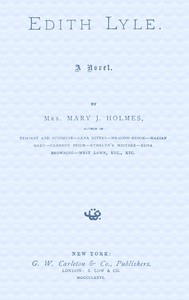
The catalog record for Edith Lyle — A Closer Reading provides practical reading context through 161,981 words, 11 hr 45 min estimated reading time, and 67 detected text sections.
The text analysis averages about 25.2 words per sentence, while the detected sections provide another way to judge how the source is divided.
Project Gutenberg metadata also associates the work with “Young women -- Fiction,” connecting these edition facts with the source record’s subject description.
Explore this collection
These alternatives are selected using recorded categories and estimated reading time.
About 429 minutes
Fantasy Juvenile Worlds
98,650 recorded words. 276 minutes difference from this book's estimate.
View Gutenberg source #71848About 360 minutes
Fantasy Juvenile Worlds
82,602 recorded words. 345 minutes difference from this book's estimate.
View Gutenberg source #69668About 346 minutes
Fantasy Juvenile Worlds
79,399 recorded words. 359 minutes difference from this book's estimate.
View Gutenberg source #72883Search stored excerpts and compare books → Choose by your preferences →
Choices use stored catalog measurements. Estimates vary with reading speed. A shared category is a catalog label, not a claim that two books have the same argument or literary quality.
Search reads excerpt text stored with this catalog and links to its associated Gutenberg record. The connection is stored in the site database; this tool does not recheck that every excerpt is word-for-word identical to that external record. Excerpt search does not cover every chapter and does not verify historical publication dates.
Catalog snapshot checked: 2026-09-26. Coverage: 100 public books, 100 available source excerpts.
Calculated from edition completeness, EPUB availability, text structure and catalogue metadata. Not a user rating.
Total of 100 points, scaled to a 2.5-5.0 range. Editions with an empty description or a missing EPUB file are not scored.
Public-domain source text
The source text is kept in the dedicated reader, separate from this catalogue record and its commentary.
The novel opens with a table of contents that lists chapters by title and number, but the first chapter is labeled “Introductory. By Esther Olivia Armstrong.” This immediately signals a layered narrative: the story will be filtered through a named observer, not an omniscient author. The excerpts show that Esther, a governess, recounts events she witnesses, such as the party preparations at Schuyler Hill and her pupil Gertie’s excitement. Her voice is present in the text, as when she writes “Mine came to the school-room, and I read it after school.” This first-person framing invites readers to watch the action through a participant’s eyes, one who is both inside and slightly apart from the household.
The excerpts reveal that Esther Olivia Armstrong is not merely a transparent narrator but a character with her own perspective. She records conversations and reactions, such as Miss Rossiter’s cold greeting to Mrs. Barton and her subsequent claim that callers came “for her sake.” Esther notes Edith’s quiet smile and understanding, showing that the narrator is attuned to subtext. When Gertie asks about the party, Esther chooses not to “enlighten her” about social barriers, indicating a protective or diplomatic stance. This narrative choice shapes how readers interpret the social maneuvering: we see both what is said and what is left unsaid.
The excerpts center on the arrival of Mrs. Barton and Rosamond, who call on the bride despite Miss Rossiter’s earlier prediction that they would snub a former governess. Miss Rossiter’s surprise and her subsequent claim that the visit was for her own sake illustrate the performative nature of social calls. Edith, however, “looked and appeared as if all her life had been passed amid just such surroundings,” suggesting a natural ease that defies class expectations. The text highlights the gap between public appearances and private resentment: Miss Rossiter “had declared war against her,” yet outwardly maintains politeness. Readers are positioned to see the tension beneath the surface.
Edith responds to Miss Rossiter’s pointed advice—not to mention her mother’s lodgers, to laugh less, to wear different dresses—with good humor and thanks, but she continues to laugh and wear her “fair, creamy arms and neck.” This is a subtle but clear defiance. She does not alter her behavior to suit the spinster’s standards. When questioned about her past, she speaks “unhesitatingly” of her mother’s lodgers, refusing to be ashamed. The narrator’s observation that Edith “understood her, and parried all her little mean thrusts” underscores a quiet competence. For a first-time reader, these details establish Edith as a character who maintains her integrity without open conflict.
Gertie, the child who stands at Esther’s side reading the invitation, provides a foil to the adult social games. Her excitement about the party—the band, lights in the trees, colored waiters in white gloves—is pure and unguarded. She does not grasp that her exclusion might be due to class or age; she only wonders if children are invited. Esther’s reply that she is “probably too young” is gentle but evasive. This moment, set against the earlier scenes of Miss Rossiter’s maneuvering, highlights the contrast between the child’s straightforward world and the adults’ coded interactions. For the reader, Gertie’s perspective offers a touchstone of sincerity amid the social performance.
As you read, pay attention to how Esther’s narration shapes your understanding of each character’s motives. The excerpts suggest that the novel’s drama lies less in overt conflict than in the accumulation of small gestures, withheld comments, and private judgments. Notice how often characters say one thing while the narrator reveals another. This layered storytelling rewards careful attention to what is implied rather than stated outright.
The rain tapped at the window that afternoon while I lingered over the editorial notes in Edith Lyle, especially the quiet friction between the narrator’s measured tone and the Schuyler Hill gossip. Somewhere between chapters, that tension reminded me of the social scrutiny in Victorian households, which sent me reaching for the Charles Dickens and other Victorians — Reading Companion on the shelf. I didn’t mean to switch books, but the afternoon simply unfolded that way.
A brief reflection can help important ideas stay with you longer.