About 291 minutes
A modern trio in an old town — Reading Companion
Fantasy Juvenile Worlds
66,781 recorded words. 0 minutes difference from this book's estimate.
View Gutenberg source #69474
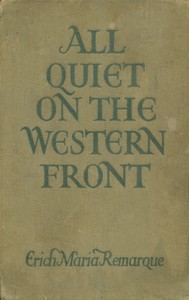
All quiet on the Western Front — Themes and Context can be approached with a clearer sense of reading commitment from its source measurements: 66,823 words, 4 hr 51 min estimated reading time, and 6 detected text sections.
The text analysis averages about 13.8 words per sentence, while the detected sections provide another way to judge how the source is divided.
Project Gutenberg metadata also associates the work with “World War, 1914-1918 -- Fiction,” connecting these edition facts with the source record’s subject description.
Explore this collection
These alternatives are selected using recorded categories and estimated reading time.
About 291 minutes
Fantasy Juvenile Worlds
66,781 recorded words. 0 minutes difference from this book's estimate.
View Gutenberg source #69474About 288 minutes
Fantasy Juvenile Worlds
66,129 recorded words. 3 minutes difference from this book's estimate.
View Gutenberg source #69185About 298 minutes
Fantasy Juvenile Worlds
68,426 recorded words. 7 minutes difference from this book's estimate.
View Gutenberg source #73740Search stored excerpts and compare books → Choose by your preferences →
Choices use stored catalog measurements. Estimates vary with reading speed. A shared category is a catalog label, not a claim that two books have the same argument or literary quality.
Search reads excerpt text stored with this catalog and links to its associated Gutenberg record. The connection is stored in the site database; this tool does not recheck that every excerpt is word-for-word identical to that external record. Excerpt search does not cover every chapter and does not verify historical publication dates.
Catalog snapshot checked: 2026-09-26. Coverage: 100 public books, 100 available source excerpts.
Calculated from edition completeness, EPUB availability, text structure and catalogue metadata. Not a user rating.
Total of 100 points, scaled to a 2.5-5.0 range. Editions with an empty description or a missing EPUB file are not scored.
Public-domain source text
The source text is kept in the dedicated reader, separate from this catalogue record and its commentary.
The novel opens not with battle but with a surplus of food: beef, haricot beans, double rations of sausage and bread, and an issue of ten cigars, twenty cigarettes, and two quids of chew per man. This abundance, the result of a miscalculation by the quartermaster after heavy losses, immediately establishes a pattern of precarious respite. The soldiers' satisfaction is measured in mess-tins and tobacco, and the cook's carroty head and ladle become emblems of a fleeting normalcy. The narrative voice, that of Paul Bäumer, moves with the company between the front and the rear, and the reader is drawn into a world where a full belly and a smoke are the highest goods.
The text is structured around a series of movements: from the front to rest, from rest back to the front, and later on leave to the home town. Each transition is marked by a shift in sensory detail. The opening chapter, set five miles behind the line, is filled with the sounds of the cook's ladle and the sight of wash-basins filled to the brim. The men are "at peace" and "in fine trim." But this peace is always temporary. The narrative does not dwell on the fighting itself; instead, it focuses on the moments before and after, the waiting and the aftermath. The journey home is rendered as a sequence of stations, each name "marking the boundaries of my youth." The train's movement becomes a physical manifestation of the soldier's dislocation.
Throughout the excerpts, tobacco and beer are not mere comforts but tokens of safety and agency. The narrator exchanges chewing tobacco for cigarettes, accumulating forty in total—"enough for a day." The canteen is described as a soldier's refuge, where beer is "far more than a drink, it is a token that a man can move his limbs and stretch in safety." The act of stretching legs and spitting deliberately is performed ceremonially. These small rituals underscore the fragility of normalcy. The smoke that hangs over the men is a constant presence, a cloud that both obscures and binds them. The attention to such details—the exchange of tobacco, the filling of mess-tins—gives the narrative a granular texture that contrasts with the abstract horror of war.
The journey home is rendered through a series of visual impressions: thatched roofs "like caps," corn-fields "gleaming like mother-of-pearl," and the soft blue silhouette of the Dolbenberg. The narrator stands at the window, holding the frame, and repeats the name of a street—"Bremerstrasse"—as if to anchor himself. The landscape is both familiar and transformed; it "embraces me as though it were my mother." Yet the return is also a leave-taking. The little brunette in the canal town is indifferent to his departure on leave, interested only if he were going to the front. The narrator's impatience to be gone is undercut by the knowledge that he will never see these places again. The train's movement, the stations, the poplars that become a block—all convey a sense of irreversible passage.
The novel repeatedly returns to the physical needs of the soldiers: sleep, food, tobacco, and the removal of lice. Katczinsky's remark that "it would not be such a bad war if only one could get a little more sleep" is a refrain that grounds the narrative in the body's exhaustion. The men are described by their appetites—Tjaden's voracity, Müller's foresight—and by their physical appearance: Leer with his full beard, the cook with his carroty head. The de-lousing that precedes the narrator's departure is a mundane but necessary ritual. These details resist any romanticization of war. The body is not heroic; it is hungry, tired, and infested. The narrative's power lies in its insistence on these concrete, unglamorous facts.
Throughout the excerpts, the rifle is a constant presence. The narrator picks up his pack, fastens the straps, and takes his rifle in hand as he stumbles from the train. The weapon is not described in terms of its power or lethality but as a burden, an object that must be carried. It is part of the soldier's equipment, like the mess-tin and the pack. The act of holding the rifle is almost automatic, a reflex. This understated treatment of the weapon is characteristic of the novel's approach: the tools of war are presented without commentary, their significance emerging from their repeated, unremarkable presence.
Readers attentive to the novel's structure will notice how each chapter or section begins with a new location or situation—rest, the front, the hospital, leave—and how the narrative moves between these spaces without transition. The effect is cumulative: the war is not a series of battles but a condition of perpetual displacement. Pay attention to the small objects and actions—the exchange of tobacco, the filling of a mess-tin, the naming of a street—as they carry the weight of the story.
Reading about Remarque’s recurring train departures and the heavy quiet of rations, I keep thinking how a single detail can anchor an entire mood—that same charge I felt flipping through The Layton Court mystery — A Reader’s Guide, where a room’s stale tobacco lingers like a held breath. Neither story lets go of its small, ordinary objects. Strange, how they hold the loudest silences.
Save your reaction, strongest insight, and memorable passage.