About 567 minutes
The curse of gold — Edition Insights
Historical Psychological Social Fiction
130,299 recorded words. 1 minutes difference from this book's estimate.
View Gutenberg source #70134
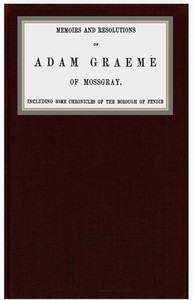
The source record for Memoirs and resolutions of Adam Graeme of Mossgray, including some chronicles of the borough of Fendie — Reading Companion measures this digital text at 130,009 words, 9 hr 26 min estimated reading time, and 15 detected text sections.
The text analysis averages about 23.3 words per sentence, while the detected sections provide another way to judge how the source is divided.
Project Gutenberg metadata also associates the work with “Bildungsromans,” connecting these edition facts with the source record’s subject description.
Explore this collection
These alternatives are selected using recorded categories and estimated reading time.
About 567 minutes
Historical Psychological Social Fiction
130,299 recorded words. 1 minutes difference from this book's estimate.
View Gutenberg source #70134About 590 minutes
Historical Psychological Social Fiction
135,603 recorded words. 24 minutes difference from this book's estimate.
View Gutenberg source #70479About 507 minutes
Historical Psychological Social Fiction
116,390 recorded words. 59 minutes difference from this book's estimate.
View Gutenberg source #70737Search stored excerpts and compare books → Choose by your preferences →
Choices use stored catalog measurements. Estimates vary with reading speed. A shared category is a catalog label, not a claim that two books have the same argument or literary quality.
Search reads excerpt text stored with this catalog and links to its associated Gutenberg record. The connection is stored in the site database; this tool does not recheck that every excerpt is word-for-word identical to that external record. Excerpt search does not cover every chapter and does not verify historical publication dates.
Catalog snapshot checked: 2026-09-26. Coverage: 100 public books, 100 available source excerpts.
Calculated from edition completeness, EPUB availability, text structure and catalogue metadata. Not a user rating.
Total of 100 points, scaled to a 2.5-5.0 range. Editions with an empty description or a missing EPUB file are not scored.
Public-domain source text
The source text is kept in the dedicated reader, separate from this catalogue record and its commentary.
The memoir begins not with a conventional scene but with a philosophical rumination on the very fact of being born. Adam Graeme, writing from a 'remote and solitary study,' calls the phrase 'he was born' more significant than 'he died,' and dwells on the soul's entrance into the world as a 'constant marvel.' This abstract opening, quoting Wordsworth, establishes a narrator who sees ordinary life as layered with mystery.
Yet the excerpts quickly move to a crowded social gathering at Mossgray, where the banker's daughter Helen Buchanan finds herself ignored by the assembled ladies. The contrast between Adam's inward, timeless reflections and the immediate, status-conscious interactions of the drawing room sets up a central tension: the memoir will shuttle between the solitary mind and the pressures of community.
The opening line—'The first thing which I can record concerning myself is, that I was born'—is deliberately paradoxical. Adam Graeme claims to record an event he cannot remember, framing his entire narrative as an attempt to recover meaning from a beginning that precedes consciousness. He contrasts the soul's 'everlasting' nature with the 'fading robe' of the body, a metaphor that recurs in his later description of death as merely changing garments. This theological vocabulary, drawn from Wordsworth's 'Intimations of Immortality' (quoted in the epigraph), gives the memoir a meditative, almost sermon-like tone. Yet the narrator undercuts his own solemnity by immediately shifting to the mundane details of Fendie society. The effect is disorienting: the reader is asked to hold both the eternal and the provincial in view at once.
In the second excerpt, Helen Buchanan becomes the focal point of a tense social drama. The narrator tracks her emotional state through small physical cues: the 'dark hue of anger on his brow' (referring to her father), the 'bitterness swelled up almost to bursting' in her heart, and the way her face 'lightened' when the Laird approaches. The banker Mr. Oswald watches her with 'angry inquisitiveness,' noting her 'swift, instantaneous movements' and the 'moving of the lip' that anticipates others' words. These details build a portrait of a woman whose inner life is legible to the reader but deliberately hidden from most characters. The scene's power lies in its asymmetry: we see what the banker sees, but also what he misses—the 'pique' and 'mercurial temperament' that drive Helen. The narrative voice, though ostensibly Adam's later recollection, here adopts a close third-person perspective on Helen, suggesting that the memoir will weave together multiple consciousnesses.
The Laird of Mossgray, an 'old man' with 'graceful old-world courtesy,' functions as a social lubricant. He deliberately draws Helen into conversation, offering his arm and bringing her to see a portrait—an act that forces the banker and the other guests to acknowledge her. The narrator notes that the Laird's intervention 'relieve[s]' Helen and that the bystanders who had 'ignored her presence' begin to 'listen now, and to draw closer.' Yet the Laird himself remains a somewhat opaque figure; his motives are not explained. He is described through his effects on others: the banker's 'secret delight' at his wife's watching, the 'proud pleasure' on William Oswald's face as he stands apart. The Laird's name, 'Mossgray,' echoes the title of the memoir, hinting that he may be a model or foil for Adam Graeme himself. But the excerpts do not reveal whether the Laird is Adam's relative or simply a neighbor; the memoir's structure leaves this connection ambiguous.
Readers should attend to the way Oliphant uses physical space and gesture to encode social hierarchies. The drawing room at Mossgray is a stage where every glance, every offered arm, every change of position carries weight. Adam Graeme's philosophical interludes may seem detached from these scenes, but they provide the interpretive lens: the memoir asks how a soul 'trailing clouds of glory' navigates the petty cruelties of a provincial borough. The tension between the eternal and the ephemeral is not resolved but held in suspension.
I’ve always treasured how Adam Graeme watches a room’s silent cruelties—that flinch of a slighted hand. Somewhere nearby, The green hat — Inside the Classic keeps its own quiet vigil over mannered wounds. They share a hush, a patience for the unspoken. Two old friends, nodding across my shelves.
Build a private reading journal entry for this title.