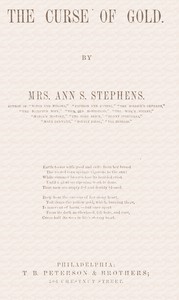
Ann S. Stephens opens The Curse of Gold with a poem that frames gold as innocent in the earth but cursed once extracted—a tension that drives the novel. The preface insists that the eccentric, avaricious Madame De Marke is drawn from a real woman living in New York around 1849, whose room is described exactly as she inhabited it. This claim of factual basis grounds the story's more extravagant elements in observed reality.
The excerpt plunges into the disordered mind of Elsie, who sees feathers as yellow wasps and speaks of a "fiery mountain" and a "hempen garment." Her encounter with her own portrait—a younger, smiling self—becomes a struggle to reconcile past innocence with present torment. Stephens uses vivid, sensory language to render psychological collapse, making the curse of gold not a moral lesson but a lived horror.
A Portrait of Madness
The excerpt centers on Elsie's confrontation with her own portrait, a scene that crystallizes the novel's psychological core. Stephens describes the portrait as "crowned with light and smiling," while Elsie, aged and tormented, approaches it "timidly as if she expected it to fly away." The painting becomes a double—a self she has lost. Elsie wonders if she is "an evil growth from the loveliness before her," a question that echoes the novel's title: gold's curse is not external but internal, a corruption of identity.
Stephens renders Elsie's fragmented thoughts through dashes, repetitions, and exclamations: "Oh! she remembered more, a thousand times more!" The prose mimics a mind overwhelmed by memory and pain. The portrait does not speak, yet Elsie's dialogue with it reveals her guilt and longing. This technique—using a static object to provoke a torrent of interior speech—gives the scene a theatrical intensity.
Gold as a Living Poison
Stephens literalizes the metaphor of gold as a curse through Elsie's hallucinations. She sees "beautiful things" turned into "vipers and stinging insects" that "come back upon me for food, eating and biting at my temples." Feathers become "a swarm of yellow wasps." This imagery transforms wealth into something predatory and animate. The novel's preface insists that Madame De Marke's "extreme parsimony" is not exaggerated, suggesting that Elsie's madness is an extreme but plausible outcome of avarice.
The setting reinforces this: the room where Elsie lives and dies is described as a prison of her own making. The "hempen garment" and "coarse" bindings contrast with the "amber brocade" of her past, a shift from luxury to penury that mirrors her mental decline. Stephens uses material details—fabric, light, insects—to externalize inner states.
The Real Woman Behind the Fiction
Stephens's preface is a striking claim: the character of Madame De Marke is drawn from a real person known in New York for "her wealth, her eccentricity, and her avaricious habits." She states that "her person, her manner of life, and her extreme parsimony, are in no respect overdrawn." This assertion invites readers to consider the novel as a kind of roman à clef, where the most improbable details are grounded in fact.
The excerpt does not name Madame De Marke, but the description of Elsie's room—with its "dull stillness" and "swarm of yellow wasps"—matches the preface's promise of exact realism. Stephens walks a line between Gothic excess and documentary precision. Readers may wonder how much of the novel's plot is invented and how much is transcribed from life. The preface offers a key, but the excerpt leaves the mystery intact.
The Curse of Gold rewards attention to its sensory details: the play of light on a portrait, the texture of a robe, the sound of a cry. Stephens builds her story from such moments, letting objects and rooms carry emotional weight. Readers who approach the novel as a psychological case study—rather than a simple moral tale—will find its strangeness compelling. The preface's claim of real-world inspiration adds a layer of documentary intrigue, but the excerpt stands on its own as a portrait of a mind undone.
That old story about gold and madness stayed with me—how a portrait can feel like a mirror of everything we hide. It made me think of another book that lingers quietly in the same way, Gloria — Key Ideas to Explore. Some tales just leave a trace, like a room you’ve sat in long after the light has faded.