About 478 minutes
Illustrations of political economy, Volume 3 (of 9) — Edition Insights
Historical Psychological Social Fiction
109,739 recorded words. 1 minutes difference from this book's estimate.
View Gutenberg source #71169
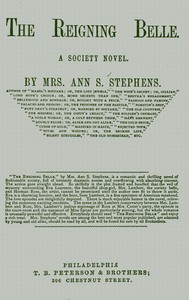
For The reigning belle — Story, Setting & Ideas, the stored edition analysis reports 109,942 words, 7 hr 59 min estimated reading time, and 78 detected text sections.
The text analysis averages about 14.1 words per sentence, while the detected sections provide another way to judge how the source is divided.
Project Gutenberg metadata also associates the work with “Young women -- Fiction,” connecting these edition facts with the source record’s subject description.
Explore this collection
These alternatives are selected using recorded categories and estimated reading time.
About 478 minutes
Historical Psychological Social Fiction
109,739 recorded words. 1 minutes difference from this book's estimate.
View Gutenberg source #71169About 489 minutes
Historical Psychological Social Fiction
112,383 recorded words. 10 minutes difference from this book's estimate.
View Gutenberg source #72642About 466 minutes
Historical Psychological Social Fiction
107,174 recorded words. 13 minutes difference from this book's estimate.
View Gutenberg source #69789Search stored excerpts and compare books → Choose by your preferences →
Choices use stored catalog measurements. Estimates vary with reading speed. A shared category is a catalog label, not a claim that two books have the same argument or literary quality.
Search reads excerpt text stored with this catalog and links to its associated Gutenberg record. The connection is stored in the site database; this tool does not recheck that every excerpt is word-for-word identical to that external record. Excerpt search does not cover every chapter and does not verify historical publication dates.
Catalog snapshot checked: 2026-09-26. Coverage: 100 public books, 100 available source excerpts.
Calculated from edition completeness, EPUB availability, text structure and catalogue metadata. Not a user rating.
Total of 100 points, scaled to a 2.5-5.0 range. Editions with an empty description or a missing EPUB file are not scored.
Public-domain source text
The source text is kept in the dedicated reader, separate from this catalogue record and its commentary.
From its first pages, The Reigning Belle establishes a world where social performance is a full-time occupation. The novel opens not with a ballroom but with a grocery store, where the clerk Boyce orchestrates his mistress's party preparations with the precision of a stage manager. Stephens lingers on the material details—red moire antique, yards of ribbon, the careful removal of fish-barrels to clear a path for the gown—that anchor the story's high-society drama in the gritty commerce of daily life. This tension between aspiration and reality runs through the excerpts, as characters measure themselves against dresses, carriages, and the approving or envious glances of neighbors.
The excerpts devote surprising attention to Boyce, a grocery clerk who functions as a backstage commentator on the social theater unfolding above him. Stephens gives him a vernacular voice full of comic exaggeration: he declares his mistress's red dress will “put down the hull bilen of ’em” and dismisses a rival's white gown as “White pigeons agin peacocks, with moons on their spread feathers!” These asides do more than provide humor; they establish a class perspective rarely granted such space in society novels. Boyce's errands—running to milliners, pocketing the change, bargaining for early store closure—reveal the economic transactions that underpin every social event. The novel thus builds its fashionable world from the ground up, showing how the labor of servants and shopkeepers enables the leisure of the elite.
Clothing in the excerpts is never merely decorative. Mrs. Smith's red moire antique becomes a weapon in a neighborhood rivalry; her daughter Jerusha Maria, denied attendance, “holds out like a trooper” and snatches at a yellow feather. The dress is described with tactile precision—“gathered up in voluminous folds”—and its passage through the store is treated as a ceremonial event, with Boyce clearing obstacles and the gown acknowledging the gesture with a “rustle and flutter.” Even the absent partygoers are defined by their attire: Jim's sister appears “in her soft white raiment, and fresh flowers,” a visual contrast that fuels Boyce's mockery. Stephens uses these fabric details to map social hierarchies, where a moire antique can outrank white muslin, and a feather can provoke near-violent longing.
The excerpts repeatedly place characters in positions of watchfulness. Boyce “haunts the stables” to time the carriage; Kate Gorman reports on Jerusha Maria's restless sleep; James is ordered to “stick to your post” and hold the child until she sleeps. This atmosphere of observation extends to the party itself, which the servants plan to watch from outside. The novel's title figure, Eva Laurence, is introduced in the catalog description as a “beautiful shop-girl” whose mystery cannot be penetrated until the author chooses to reveal it. The excerpts suggest that secrets are not confined to the drawing room: the grocery store, the landing, and the nursery are equally sites of espionage, where every rustle of silk or dose of paregoric carries social weight. Stephens builds suspense not through grand revelations but through the accumulation of these small, watched moments.
Readers approaching The Reigning Belle should attend to the spaces between grand scenes: the back stairways, the corner stores, the nurseries where children are dosed into silence. Stephens's novel earns its subtitle “A Society Novel” not by celebrating high life but by exposing the labor, envy, and calculation that sustain it. The excerpts offer no ballroom dialogue, yet they convey the social stakes of every ribbon and carriage wheel with remarkable economy.
That Reigning Belle book stayed with me because of how much it hid under all that Gilded Age polish—the shop girl’s quiet ache next to the belle’s careful secrets. It made me think of Dusty answer — Key Ideas to Explore, which touches that same tender nerve about who we pretend to be. I keep circling back to it, the way you do a memory you can’t quite place.
Build a private reading journal entry for this title.