About 804 minutes
The curse of Clifton — Story, Setting & Ideas
Historical Psychological Social Fiction
184,752 recorded words. 126 minutes difference from this book's estimate.
View Gutenberg source #70776
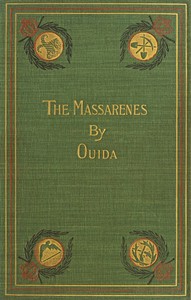
This digital edition of The Massarenes — Text and Context is described by source-level measurements including 213,881 words, 15 hr 30 min estimated reading time, and 57 detected text sections.
The text analysis averages about 18.6 words per sentence, while the detected sections provide another way to judge how the source is divided.
Project Gutenberg metadata also associates the work with “Rich people -- Fiction,” connecting these edition facts with the source record’s subject description.
Explore this collection
These alternatives are selected using recorded categories and estimated reading time.
About 804 minutes
Historical Psychological Social Fiction
184,752 recorded words. 126 minutes difference from this book's estimate.
View Gutenberg source #70776About 719 minutes
Historical Psychological Social Fiction
165,238 recorded words. 211 minutes difference from this book's estimate.
View Gutenberg source #69952About 699 minutes
Historical Psychological Social Fiction
160,752 recorded words. 231 minutes difference from this book's estimate.
View Gutenberg source #74706Search stored excerpts and compare books → Choose by your preferences →
Choices use stored catalog measurements. Estimates vary with reading speed. A shared category is a catalog label, not a claim that two books have the same argument or literary quality.
Search reads excerpt text stored with this catalog and links to its associated Gutenberg record. The connection is stored in the site database; this tool does not recheck that every excerpt is word-for-word identical to that external record. Excerpt search does not cover every chapter and does not verify historical publication dates.
Catalog snapshot checked: 2026-09-26. Coverage: 100 public books, 100 available source excerpts.
Calculated from edition completeness, EPUB availability, text structure and catalogue metadata. Not a user rating.
Total of 100 points, scaled to a 2.5-5.0 range. Editions with an empty description or a missing EPUB file are not scored.
Public-domain source text
The source text is kept in the dedicated reader, separate from this catalogue record and its commentary.
Ouida opens The Massarenes with a conversation at Homburg that immediately establishes her method: a husband points out a 'large pale woman' with a 'face like a crumpled whitey-brown paper bag,' and his wife, Lady Kenilworth, responds with calculated interest. The woman is Mrs. Massarene, a wealthy American-made fortune holder, and the dialogue reveals the casual cruelty and transactional nature of aristocratic society. The husband's suggestion to 'cotton to her if you can. There’s money to be made' sets the tone for a novel where social advancement is a mercenary game. Ouida's diction—'wallows,' 'dead broke,' 'flimsy'—is deliberately coarse, contrasting with the polished setting. The opening also introduces a recurring motif: the 'unelect' who are 'not in it,' signaling the novel's preoccupation with exclusion and the performance of belonging.
Ouida’s word choices often function as a form of social critique. In the opening, the husband describes Mrs. Massarene as 'rolling' and 'wallowing,' verbs that reduce her to a physical, almost animal presence. Later, a character reflects on women who have 'lost their natural position' and are 'nowhere at home,' a phrase that echoes the novel’s concern with displacement. The narrator uses 'pêches à quinze series'—a French term for cheap peaches—to dismiss compromised women, blending snobbery with culinary metaphor. These lexical choices are never neutral; they carry the weight of class judgment. Ouida also employs colloquialisms like 'stone broke' and 'dead broke' to puncture pretension, while the repeated use of 'flimsy' to describe money or reputation underscores the fragility of social standing. The effect is a narrative voice that is both complicit in and critical of the world it depicts.
Ouida structures scenes around moments of social exposure. Lady Kenilworth’s internal panic over a pawned diamond—'she could not see anyone until she could find out some way of exit from this hideous labyrinth of trouble'—is rendered in long, breathless sentences that mimic her agitation. The narrative shifts between external dialogue and interior monologue, revealing the gap between public composure and private dread. The setting itself—Homburg, a spa town—serves as a liminal space where social rules are both relaxed and intensified. Characters are constantly observed: Mrs. Massarene sits 'in solitude under a tree,' her isolation marked by the 'desolate air of “not being in it.”' Ouida uses these spatial details to map social hierarchies, placing the 'unelect' in plain sight yet invisible to the elect. The novel’s structure, with its 57 sections, allows for multiple perspectives, but the focus remains on the psychological cost of maintaining appearances.
Two motifs recur in the excerpts: the diamond and the debt. The diamond, a 'roc’s egg' that must be retrieved from Paris, becomes a symbol of Lady Kenilworth’s precarious position—she must replace it before her brother detects the forgery. The debt, meanwhile, is both financial and social: characters are 'stone broke' or 'dead broke,' and the threat of exposure looms. Ouida uses these motifs to create tension, but also to comment on the material basis of social status. The diamond is a test of loyalty; the men who might retrieve it are judged by their 'adoration' and 'honor.' Yet the narrator undercuts this idealism: 'there are very pretty theories and ideals about the honor of men of the world, but she knew such men down to the ground.' The motifs thus serve a dual function, driving plot while exposing the transactional nature of relationships in this milieu.
Dialogue in The Massarenes is rarely straightforward; it is a performance of status. The opening exchange between Lord and Lady Kenilworth is a duet of cynicism: 'Hush! somebody will hear,' she says, while he chuckles. Their conversation is coded, using nicknames ('Boo') and elliptical references ('old Khris') that exclude outsiders. Later, Lady Kenilworth’s command—'I am at home to no one'—is a social act, a way of controlling access. Ouida also uses dialogue to reveal character through indirect means: when Lady Kenilworth thinks of her brother, she recalls his 'unsuspicious stupidity,' a phrase that tells us more about her contempt than his actual nature. The dialogue is often sharp and epigrammatic, as when a character dismisses a social climber: 'Nobody discovered her? Nobody taken her up?' The question implies that social worth is conferred by recognition, not inherent merit. Through such exchanges, Ouida dramatizes the constant negotiation of power and place.
Readers should attend to Ouida’s narrative voice, which shifts between ironic distance and psychological intimacy. The novel’s length (over 200,000 words) allows for extensive development of social networks and internal conflicts. Pay particular attention to how Ouida uses physical description—a face like crumpled paper, a woman who 'rolls'—to encode moral and social judgments. The excerpts suggest a work that is both a satire of the nouveau riche and a sympathetic portrait of those trapped by their own ambitions. The African episode mentioned in the author’s note may offer a contrast to the European settings, but its full significance is not evident from the provided text.
Reading about the Massarenes’ brittle social climb, I remembered my grandmother’s story of a wealthy aunt who bought respect but never her neighbors’ warmth. That ache of exclusion lingered oddly in my hands. A later book, Chateau d'Or, Norah, and Kitty Craig — Key Ideas to Explore, offered the same strange comfort—seeing how love, unlike money, doesn’t ask for proof of worth.
Answer a few questions and save a private reflection on this device.