About 308 minutes
Madam Constantia — Background and Themes
Fantasy Juvenile Worlds
70,780 recorded words. 4 minutes difference from this book's estimate.
View Gutenberg source #70174
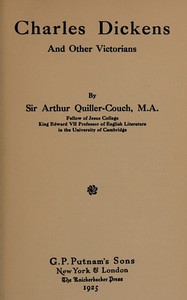
This digital edition of Charles Dickens and other Victorians — Reading Companion is described by source-level measurements including 69,905 words, 5 hr 4 min estimated reading time, and 19 detected text sections.
The text analysis averages about 27.1 words per sentence, while the detected sections provide another way to judge how the source is divided.
Project Gutenberg metadata also associates the work with “Thackeray, William Makepeace, 1811-1863,” connecting these edition facts with the source record’s subject description.
Explore this collection
These alternatives are selected using recorded categories and estimated reading time.
About 308 minutes
Fantasy Juvenile Worlds
70,780 recorded words. 4 minutes difference from this book's estimate.
View Gutenberg source #70174About 298 minutes
Fantasy Juvenile Worlds
68,426 recorded words. 6 minutes difference from this book's estimate.
View Gutenberg source #73740About 291 minutes
Fantasy Juvenile Worlds
66,781 recorded words. 13 minutes difference from this book's estimate.
View Gutenberg source #69474Search stored excerpts and compare books → Choose by your preferences →
Choices use stored catalog measurements. Estimates vary with reading speed. A shared category is a catalog label, not a claim that two books have the same argument or literary quality.
Search reads excerpt text stored with this catalog and links to its associated Gutenberg record. The connection is stored in the site database; this tool does not recheck that every excerpt is word-for-word identical to that external record. Excerpt search does not cover every chapter and does not verify historical publication dates.
Catalog snapshot checked: 2026-09-26. Coverage: 100 public books, 100 available source excerpts.
Calculated from edition completeness, EPUB availability, text structure and catalogue metadata. Not a user rating.
Total of 100 points, scaled to a 2.5-5.0 range. Editions with an empty description or a missing EPUB file are not scored.
Public-domain source text
The source text is kept in the dedicated reader, separate from this catalogue record and its commentary.
Quiller-Couch opens his lecture on Dickens not with the novelist himself but with Westminster Hall, praising its oak roof that repels spiders and its procession of historical figures. This characteristic move—starting at a physical, almost architectural distance before homing in on his subject—reveals his method throughout the collection: he builds context through analogy, allusion, and a deliberately conversational tone. The preface notes that all but one of these papers were delivered as lectures at Cambridge, and the text retains the repetitions and reminders of oral delivery. Quiller-Couch explicitly frames his project as an attempt at judgment on Dickens and Thackeray as full novelists, while the essays on Disraeli and Mrs. Gaskell take a single theme to show how it works upon two different minds.
Quiller-Couch warns readers in his preface that the lectures “abound therefore with repetitions and reminders which the reader must try to forgive.” This is not a rhetorical gesture: the text bears out the claim. In the Dickens section, he returns multiple times to the idea of literary squabbling as a waste of talent, using The Dunciad as a recurring example. He also repeats the image of Thackeray’s height and melancholy—calling him “this tall fellow of six-feet-four” and later “a lumbering, unathletic figure with a slouch”—as if reinforcing a portrait for an audience that might have missed the first mention. The effect is less polished than a written monograph but more immediate, preserving the rhythm of a spoken performance.
Quiller-Couch identifies a “strain of melancholy” in Thackeray, tracing it to “inherited Anglo-Indian melancholy” and “the tragedy of his marriage.” He argues this melancholy underlies the refrain “Vanity, vanity, all is vanity” that runs through Thackeray’s work. But the critic’s real interest lies in Thackeray’s lack of envy toward other writers. He quotes a letter in which Thackeray praises David Copperfield as “beautiful” and “charming,” calling it “the touchstone” of a generous literary character. This focus on professional ethics—on how writers treat one another—is a thread that connects the essays, as Quiller-Couch contrasts Thackeray’s behavior with the “literary broils and squabbles” he deplores in the Dickens lecture.
Quiller-Couch’s essay on Trollope confines itself almost wholly to the Barsetshire novels, provoked by a recent edition. He argues that Trollope’s “bulk is a part of his quality: it can no more be separated from the man than can Falstaff’s belly from Falstaff.” This physical metaphor is typical of Quiller-Couch’s style—earthy, allusive, and slightly mischievous. He suggests that a full estimate of Trollope awaits a complete edition, because “no critic can talk usefully about books to many of which his hearers have no access.” The remark is both a practical observation about the limits of criticism and a subtle dig at the three-volume-novel system that inflated Trollope’s reputation in one generation and killed it in the next.
Readers coming to this collection should expect a critic who wears his learning lightly but insists on concrete evidence. Quiller-Couch quotes letters, cites specific novels, and names authors from Uhland to Hazlitt, but he never loses sight of the desk from which he lectures. The essays are best approached as performances: they reward attention to their rhetorical structure and to the recurring motifs—architectural spaces, physical descriptions of authors, and the ethics of literary judgment—that give the collection its coherence.
Quiller-Couch’s lectures felt like sitting in a lamplit study, hearing someone care more about how a sentence is stitched than who “won” some literary feud. That same unhurried, humane attention drifts through Rogues and vagabonds — Background and Themes, which kept me company long after I finished, much like this old professor’s voice does.
Answer a few questions and save a private reflection on this device.