About 79 minutes
Glen's Creek — Reading Companion
Exploration Survival Adventure Tales
18,060 recorded words. 21 minutes difference from this book's estimate.
View Gutenberg source #70191
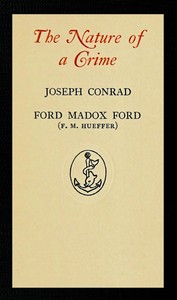
The nature of a crime — A Reader’s Guide can be approached with a clearer sense of reading commitment from its source measurements: 22,806 words, 1 hr 40 min estimated reading time, and 13 detected text sections.
The text analysis averages about 20.1 words per sentence, while the detected sections provide another way to judge how the source is divided.
Project Gutenberg metadata also associates the work with “Epistolary fiction,” connecting these edition facts with the source record’s subject description.
Explore this collection
These alternatives are selected using recorded categories and estimated reading time.
About 79 minutes
Exploration Survival Adventure Tales
18,060 recorded words. 21 minutes difference from this book's estimate.
View Gutenberg source #70191About 58 minutes
Exploration Survival Adventure Tales
13,216 recorded words. 42 minutes difference from this book's estimate.
View Gutenberg source #71775About 207 minutes
Exploration Survival Adventure Tales
47,386 recorded words. 107 minutes difference from this book's estimate.
View Gutenberg source #74435Search stored excerpts and compare books → Choose by your preferences →
Choices use stored catalog measurements. Estimates vary with reading speed. A shared category is a catalog label, not a claim that two books have the same argument or literary quality.
Search reads excerpt text stored with this catalog and links to its associated Gutenberg record. The connection is stored in the site database; this tool does not recheck that every excerpt is word-for-word identical to that external record. Excerpt search does not cover every chapter and does not verify historical publication dates.
Catalog snapshot checked: 2026-09-26. Coverage: 100 public books, 100 available source excerpts.
Calculated from edition completeness, EPUB availability, text structure and catalogue metadata. Not a user rating.
Total of 100 points, scaled to a 2.5-5.0 range. Editions with an empty description or a missing EPUB file are not scored.
Public-domain source text
The source text is kept in the dedicated reader, separate from this catalogue record and its commentary.
The preface to The Nature of a Crime sets an unusual frame: Conrad describes the work as a 'fragment' that 'emerges from the depths of a past,' a piece of collaboration he had nearly forgotten. The novel itself is an epistolary confession, written by a man who insists he is 'a dead man' even as he details his final gamble—a corner in a commodity essential to the City. The narrative oscillates between abstract meditations on thought versus action and the concrete mechanics of bribery and market manipulation. This tension between the speculative and the material defines the work's structure, as the protagonist's voice shifts from philosophical detachment to urgent, almost frantic, planning.
The novel’s structure is built around a journey toward a deathbed—the protagonist writes as he travels, his mind 'wandering away from the main fact' of his impending death. This movement gives the confession a restless quality: scenes of introspection are interrupted by recollections of past actions, and the reader is never allowed to settle. The epistolary form itself becomes a kind of action, a 'protest against being called a man of action.' The narrator’s voice is both intimate and evasive, circling around the crime he has committed—an embezzlement—without ever naming it directly. Instead, he frames his actions as a 'thought made up of an almost infinite number of erring calculations,' a phrase that captures the novel’s interest in the gap between intention and consequence.
The protagonist’s self-justification relies on a distinction between gambling and speculation: 'the speculator acts for gain: the gambler in order to interest himself.' This logic permeates his description of the corner scheme, which he presents as a way to escape his thoughts of a woman. The novel’s recurring image of gambling—'divining the undivinable future'—links the financial plot to the narrator’s emotional state. He depends on 'the caprice of the weather or the movement in the minds of men more insane than yourself,' a formulation that echoes his own instability. The text’s movement between abstract reasoning and vivid detail (the 'momentary madness of a dozen men who declare a war') creates a rhythm of withdrawal and return, mirroring the narrator’s inability to sustain either thought or action.
The setting is almost entirely interior—the narrator’s mind, his rooms, the anonymous spaces of financial transactions. Yet the City looms as a presence, its daily life dependent on the commodity he seeks to corner. The novel’s few concrete images are drawn from this world: 'the men with whom one struggles, the men whom one must bribe or trick.' The protagonist’s relationships are reduced to these transactional terms, even his connection to the unnamed woman he addresses. The preface’s mention of 'unscrupulous, cultivated, high-minded jouisseurs' in 'square-skirted, long frock-coats' suggests a specific historical milieu, but the text itself remains claustrophobically focused on the narrator’s consciousness. This narrowing of scope—from the City’s vast machinery to a single dying mind—gives the novel its peculiar intensity.
Conrad’s preface insists that the work is 'rounded as it is in form' yet remains 'a fragment from its very nature.' This paradox is central to the reading experience: the novel ends abruptly, with the protagonist’s fate unresolved. The collaborative origin—Conrad and Ford writing in alternation—may explain some of the text’s discontinuities, but the preface frames these as deliberate. The narrator’s voice, too, is fragmented: he shifts between addressing his correspondent, reflecting on his own psychology, and describing the mechanics of his scheme. The result is a work that feels like a series of overlapping monologues, each circling the same obsessions. Readers should attend to the gaps—the moments where the narrator’s logic breaks down, where the confession becomes a performance.
The Nature of a Crime rewards attention to its structure of delay and return. The narrator’s insistence that he is 'no man of action' invites skepticism; his elaborate justifications may be as much a trap for the reader as for himself. The novel’s brevity—under 23,000 words—belies its density of implication. Approach it as a study in self-deception, where the crime is less the embezzlement than the narrator’s refusal to see himself clearly.
I finished The Nature of a Crime last night and it stayed with me — that strange way he talks himself into ruin, thought and deed blurring until the confession becomes the crime. It reminded me of another quiet unraveling, whispered rather than shouted. The prior claim — A Reader’s Guide carries that same ache, the weight of an intention never quite arrived at.
Build a private reading journal entry for this title.