About 290 minutes
Moll Davis: a comedy — Story, Setting & Ideas
Historical Psychological Social Fiction
66,485 recorded words. 2 minutes difference from this book's estimate.
View Gutenberg source #69720
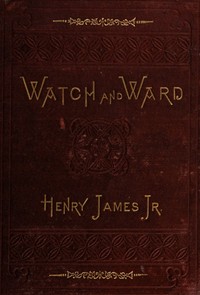
Watch and ward — Text and Context can be approached with a clearer sense of reading commitment from its source measurements: 66,042 words, 4 hr 48 min estimated reading time, and 12 detected text sections.
The text analysis averages about 14.4 words per sentence, while the detected sections provide another way to judge how the source is divided.
Project Gutenberg metadata also associates the work with “Love stories,” connecting these edition facts with the source record’s subject description.
Explore this collection
These alternatives are selected using recorded categories and estimated reading time.
About 290 minutes
Historical Psychological Social Fiction
66,485 recorded words. 2 minutes difference from this book's estimate.
View Gutenberg source #69720About 297 minutes
Historical Psychological Social Fiction
68,099 recorded words. 9 minutes difference from this book's estimate.
View Gutenberg source #75146About 305 minutes
Historical Psychological Social Fiction
70,120 recorded words. 17 minutes difference from this book's estimate.
View Gutenberg source #71228Search stored excerpts and compare books → Choose by your preferences →
Choices use stored catalog measurements. Estimates vary with reading speed. A shared category is a catalog label, not a claim that two books have the same argument or literary quality.
Search reads excerpt text stored with this catalog and links to its associated Gutenberg record. The connection is stored in the site database; this tool does not recheck that every excerpt is word-for-word identical to that external record. Excerpt search does not cover every chapter and does not verify historical publication dates.
Catalog snapshot checked: 2026-09-26. Coverage: 100 public books, 100 available source excerpts.
Calculated from edition completeness, EPUB availability, text structure and catalogue metadata. Not a user rating.
Total of 100 points, scaled to a 2.5-5.0 range. Editions with an empty description or a missing EPUB file are not scored.
Public-domain source text
The source text is kept in the dedicated reader, separate from this catalogue record and its commentary.
Henry James's first novel, Watch and Ward, originally serialized in the Atlantic Monthly in 1871 and revised for book publication in 1878, opens with a meticulous portrait of its protagonist, Roger Lawrence. The narrator dwells on his 'compact and sturdy' figure, his 'too early baldness', and his 'fastidiously neat' person—details that establish a man governed by method and diffidence. The catalog subjects list 'Love stories', 'Mate selection', and 'Guardian and ward', but the excerpts show a narrative more interested in psychological nuance than romantic convention. Roger's scheme to raise a ward as his wife is presented not as a scandal but as a quiet, almost bureaucratic project, and the prose lingers on his internal hesitations rather than dramatic action.
The opening chapter devotes several paragraphs to Roger Lawrence's appearance and habits before any plot unfolds. The narrator notes his 'genius, almost, for common-sense', his 'incurable personal shyness', and his 'formalism of manner which many persons found extremely amusing'. These traits are not merely descriptive; they shape the novel's central tension. Roger's desire to marry his ward is presented as an extension of his orderly nature—a plan to be executed with the same precision he applies to choosing a shoemaker. The catalog subject 'Guardian and ward' suggests a legal or moral drama, but the excerpts emphasize Roger's internal world: his 'ardor rapidly ebbing' as he approaches a proposal, his reliance on 'despair' rather than hope. The narrator's tone is analytical, almost clinical, treating Roger's emotions as phenomena to be observed rather than shared.
A later excerpt shifts to a dinner party where Roger converses with Miss Sands, a woman he initially suspects of being part of a matchmaking scheme. The scene hinges on a confession: Roger admits he is 'in love' with his protégée, a young woman he has 'brought up with the view of making her my wife'. The dialogue is layered with social performance—Roger's 'stiff' questions about piano-playing, Miss Sands's blush that is 'portentous, formidable, tragical'. The narrator notes that Roger 'felt with peculiar intensity' that their hostess was 'a sadly superficial,—in fact a positively immoral,—old woman'. This moment reveals the novel's interest in the gap between public decorum and private intention. The catalog subject 'Mate selection' is here literalized as a negotiation between characters who are only partly aware of each other's motives.
The excerpts display a narrator who is both intimate and ironic. Phrases like 'I may almost say, by despair' and 'he may have the benefit of the possibility' create a tone of detached commentary. The narrator knows Roger's thoughts but also judges them: Roger's 'painful sense of having but partly succeeded in giving himself the figure of an impassioned suitor' is described with a mixture of sympathy and amusement. This voice complicates the catalog subject 'Love stories', which implies a straightforward romance. Instead, the novel seems to examine the ethics of Roger's project—raising a girl to be his wife—without explicit condemnation. The excerpts do not reveal Nora's perspective, leaving the reader to infer her agency from Roger's anxieties and the reactions of other characters. The narrative withholds moral clarity, focusing instead on the subtle mechanics of desire and control.
Readers approaching Watch and Ward should attend to the narrator's tone as much as the plot. James's early style is already marked by a preference for psychological shading over dramatic incident. The novel's brevity—around 66,000 words—and its serial origins may explain its episodic structure. The excerpts suggest a work that rewards attention to small gestures, such as the 'hand-screen' behind which Mrs. Middleton sleeps, and to the precise vocabulary of Roger's self-deception.
I kept thinking about how Henry James watches Roger plan everything, yet the girl slips through his neat design, and it reminded me of something quieter in A girl and her ways — A Closer Reading—how intentions and real feelings rarely meet on schedule. That drawing-room confession stayed with me, a small crack in a careful life.
Build a private reading journal entry for this title.