About 290 minutes
Moll Davis: a comedy — Story, Setting & Ideas
Historical Psychological Social Fiction
66,485 recorded words. 7 minutes difference from this book's estimate.
View Gutenberg source #69720
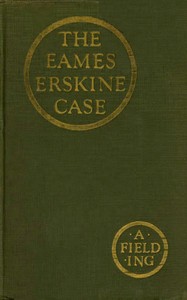
The source record for The Eames-Erskine case — Key Ideas to Explore measures this digital text at 68,099 words, 4 hr 57 min estimated reading time, and 14 detected text sections.
The text analysis averages about 14.1 words per sentence, while the detected sections provide another way to judge how the source is divided.
Project Gutenberg metadata also associates the work with “Detective and mystery stories,” connecting these edition facts with the source record’s subject description.
Explore this collection
These alternatives are selected using recorded categories and estimated reading time.
About 290 minutes
Historical Psychological Social Fiction
66,485 recorded words. 7 minutes difference from this book's estimate.
View Gutenberg source #69720About 305 minutes
Historical Psychological Social Fiction
70,120 recorded words. 8 minutes difference from this book's estimate.
View Gutenberg source #71228About 288 minutes
Historical Psychological Social Fiction
66,042 recorded words. 9 minutes difference from this book's estimate.
View Gutenberg source #72355Search stored excerpts and compare books → Choose by your preferences →
Choices use stored catalog measurements. Estimates vary with reading speed. A shared category is a catalog label, not a claim that two books have the same argument or literary quality.
Search reads excerpt text stored with this catalog and links to its associated Gutenberg record. The connection is stored in the site database; this tool does not recheck that every excerpt is word-for-word identical to that external record. Excerpt search does not cover every chapter and does not verify historical publication dates.
Catalog snapshot checked: 2026-09-26. Coverage: 100 public books, 100 available source excerpts.
Calculated from edition completeness, EPUB availability, text structure and catalogue metadata. Not a user rating.
Total of 100 points, scaled to a 2.5-5.0 range. Editions with an empty description or a missing EPUB file are not scored.
Public-domain source text
The source text is kept in the dedicated reader, separate from this catalogue record and its commentary.
The Eames-Erskine Case opens with a silent intrusion: four plainclothes detectives enter a hotel room, and the first object of scrutiny is a wardrobe with a knot-hole. This piece of furniture becomes the story's central image—a container of secrets, examined with the meticulous care of a would-be purchaser finding a flaw. The narrative structure mirrors this attention to hidden spaces, moving from the hotel room to Scotland Yard, then to a Canadian's flat and a Geneva solicitor's office, each location a new compartment to be opened.
Chief Inspector Pointer, introduced as a methodical observer, carries this structural pattern forward. His investigation proceeds not through dramatic revelations but through patient accumulation: reports from America, a telegram to Geneva, a young woman's unexpected visit. The excerpts show a story built around the tension between what is visible and what is concealed, with the wardrobe's knot-hole serving as a recurring metaphor for the gaps in evidence that Pointer must probe.
The opening scene establishes the wardrobe as more than a clue—it is the story's organizing device. The detectives lift its top, lay it on its side, photograph it, and extract a body. This physical handling of the object mirrors the narrative's method: each chapter unpacks a new layer of the case. The knot-hole, described as a hole that Pointer inserts his finger into as gently as a mother feeling her baby's tooth, becomes a focal point for the reader's attention, a small aperture through which the larger mystery must be viewed.
Later, the investigation returns to the idea of containers: a strip of green and white paper that might have held something, a will that reveals no available funds, a locked wardrobe in a hotel room. The structure of the novel itself resembles a series of nested boxes, with each new piece of information requiring the reader to reconsider what came before. The hotel manager's back garden is dug up, but the real digging is into the past of the accused, Carter, and the elusive Mr. Beale.
The excerpts trace a deliberate geography of confinement. The story begins in a hotel room—a temporary, impersonal space—then moves to Pointer's lodgings, where he receives visitors in his sitting room. The Canadian suspect's flat is another closed environment, and the Geneva solicitor's office represents a foreign extension of the investigation. Each location is described with attention to its boundaries: doors that open noiselessly, corridors where detectives watch for lingering figures, chairs pulled into the light for questioning.
This movement between spaces creates a rhythm of enclosure and release. The hotel room is a crime scene, Pointer's rooms are a site of analysis, and the journey to Geneva is an attempt to break out of the evidentiary dead end. The recurring image of the large box carried by the first detective echoes throughout—the case itself is a box to be opened, and each new scene offers a potential key.
Pointer's method is built on small, repeated actions: peering, running a finger around a hole, examining a piece of furniture with meticulous care. These gestures recur throughout the excerpts, creating a pattern of scrutiny that defines the narrative voice. The detective looks over Mr. Beale almost as carefully as he had the wardrobe, linking the man to the object. Later, the young woman gives Pointer the longest, keenest look the police-officer had ever had from a woman, reversing the gaze.
Concealment is equally patterned. Beale folds his hands over his ample front and purses a cruel mouth, a physical withholding that matches his verbal evasions. The accused Carter refuses to speak, offering no alibi. Even the dead man, Erskine, is said to have alluded to a stolen hoard without indicating where it might be found. The narrative itself withholds information, doling out details through reports, telegrams, and letters that are summarized rather than quoted directly.
Mr. Beale, the American gentleman, enters the story as a catalyst. He is the one who notices the knot-hole, who moves the wardrobe, who insists on police involvement. Yet his role remains ambiguous throughout the excerpts. Pointer notes that Beale does not strike him as the kind of man to occupy such a simple room—a discrepancy of setting that hints at a hidden purpose. Beale's voice wraps the Stars and Stripes around him, marking him as an outsider in the English hotel, and his insistence on seeing Carter becomes a recurring puzzle.
The narrative uses Beale to introduce a transatlantic dimension. Reports from America clear him of suspicion, yet Pointer remains convinced Beale is playing a game. The young woman who later visits Pointer is also American, her accent revealing her origin before she speaks. This pattern of American characters entering English spaces creates a structural tension between the known and the foreign, mirroring the investigation's movement from the hotel room to Geneva and back.
The excerpts leave several threads unresolved: Beale's motive, Carter's silence, the contents of the green and white paper. Readers should attend to the way Fielding uses physical objects—the wardrobe, the knot-hole, the wax vesta—as anchors for the plot's psychological undercurrents. The story rewards attention to small details and to the spaces between scenes, where characters move from one confined setting to another, each transition offering a new angle on the central mystery.
I found myself thinking of the wardrobe’s locked door and how some secrets simply wait for the right kind of quiet. It brought back an afternoon at my grandmother’s, the same hush in her hallway. The curse of Clifton — Story, Setting & Ideas once gave me that identical feeling, of rooms holding their breath until someone finally turns the key.
Your answers remain private and are stored only in this browser.