About 313 minutes
The house of the wizard — Edition Insights
Historical Psychological Social Fiction
71,774 recorded words. 8 minutes difference from this book's estimate.
View Gutenberg source #70156
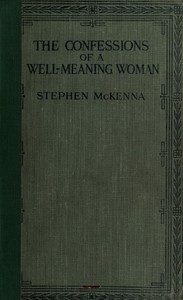
The source record for The confessions of a well-meaning woman — Themes and Context measures this digital text at 70,120 words, 5 hr 5 min estimated reading time, and 6 detected text sections.
The text analysis averages about 17.1 words per sentence, while the detected sections provide another way to judge how the source is divided.
Project Gutenberg metadata also associates the work with “Women -- England -- Fiction,” connecting these edition facts with the source record’s subject description.
Explore this collection
These alternatives are selected using recorded categories and estimated reading time.
About 313 minutes
Historical Psychological Social Fiction
71,774 recorded words. 8 minutes difference from this book's estimate.
View Gutenberg source #70156About 297 minutes
Historical Psychological Social Fiction
68,099 recorded words. 8 minutes difference from this book's estimate.
View Gutenberg source #75146About 290 minutes
Historical Psychological Social Fiction
66,485 recorded words. 15 minutes difference from this book's estimate.
View Gutenberg source #69720Search stored excerpts and compare books → Choose by your preferences →
Choices use stored catalog measurements. Estimates vary with reading speed. A shared category is a catalog label, not a claim that two books have the same argument or literary quality.
Search reads excerpt text stored with this catalog and links to its associated Gutenberg record. The connection is stored in the site database; this tool does not recheck that every excerpt is word-for-word identical to that external record. Excerpt search does not cover every chapter and does not verify historical publication dates.
Catalog snapshot checked: 2026-09-26. Coverage: 100 public books, 100 available source excerpts.
Calculated from edition completeness, EPUB availability, text structure and catalogue metadata. Not a user rating.
Total of 100 points, scaled to a 2.5-5.0 range. Editions with an empty description or a missing EPUB file are not scored.
Public-domain source text
The source text is kept in the dedicated reader, separate from this catalogue record and its commentary.
Lady Ann Spenworth, convalescing after an operation, immediately frames her illness as a social performance: she regrets not having the surgery at home because 'it is one's frame and setting,' and suspects the nursing-home of profiteering. Her voice—confiding, aggrieved, and morally selective—dominates the opening chapter. She mentions a £500 payment from her sister-in-law Ruth, which she accepts while resenting the implication of charity. The narrative is structured as a series of confessions to a silent listener, a device that lets Lady Ann control what is revealed and how it is spun.
Lady Ann’s narration is the book’s primary engine. She speaks in long, sinuous sentences that mix indignation with self-deprecation, as when she notes that her brother Brackenbury and sister-in-law Ruth 'spied on, whispered about' her. The confidante is addressed as 'you,' creating an intimacy that feels both privileged and manipulative. Lady Ann admits to withholding information—'I shall not tell you about that'—and to interpreting events to her advantage. The reader is placed in the position of the confidante, asked to sympathize but given reason to doubt.
Financial anxiety runs beneath Lady Ann’s complaints. She and her husband Arthur 'have not been in a position to have any painting or papering done for so long,' yet she refuses Ruth’s offer to pay for the operation, calling it 'spasmodic charity.' The £500 is accepted but resented. Later, her son Will has 'nothing to live on' after losing an appointment, and she insists he 'must marry or find a job.' The excerpts show a world where money is never discussed directly but always present—as leverage, shame, or necessity. Lady Ann’s class position requires her to maintain appearances while privately counting costs.
Lady Ann recounts two family troubles: her niece Phyllida’s failed romance with a man named Butler, and her son Will’s entanglement with a girl from Morecambe. In both cases, she presents herself as a reasonable mediator. Of Phyllida, she says 'the trouble was ... that Phyllida’s vanity was hurt.' Of Will, she describes the girl as a 'trap' and the father’s visit as a 'blackmailing expedition.' Yet she admits she does not know what Will 'is supposed to have done.' The gaps in her knowledge are telling: she controls the story by omitting details that might undermine her version. The reader is left to weigh her self-serving interpretations against the hints of other perspectives.
The excerpts offer a portrait of a narrator who is both unreliable and compelling. Lady Ann’s confessions invite scrutiny: her claims of victimhood, her selective memory, and her sharp observations of others all suggest a woman adept at managing her own image. Readers should attend to what she says and what she leaves out, and consider how the silent confidante—and by extension the reader—is being positioned. The novel’s title promises confession, but the text delivers performance.
I finished Lady Ann’s confessions and felt that odd ache of watching someone lie to herself so gracefully. Her need to keep up appearances reminded me of another voice I once sat with, quieter but just as persistent. There’s a book called Gloria — Key Ideas to Explore that left the same soft, uncomfortable weight with me.
Use these questions to collect your thoughts before moving on.