About 199 minutes
Among the gnomes — Reading Notes
Fantasy Juvenile Worlds
45,743 recorded words. 1 minutes difference from this book's estimate.
View Gutenberg source #73860
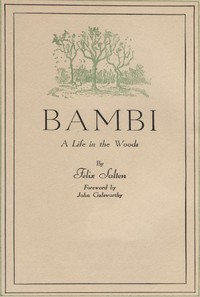
Bambi — Themes and Context can be approached with a clearer sense of reading commitment from its source measurements: 45,871 words, 3 hr 20 min estimated reading time, and 6 detected text sections.
The text analysis averages about 11.0 words per sentence, while the detected sections provide another way to judge how the source is divided.
Project Gutenberg metadata also associates the work with “Nature stories,” connecting these edition facts with the source record’s subject description.
Explore this collection
These alternatives are selected using recorded categories and estimated reading time.
About 199 minutes
Fantasy Juvenile Worlds
45,743 recorded words. 1 minutes difference from this book's estimate.
View Gutenberg source #73860About 193 minutes
Fantasy Juvenile Worlds
44,244 recorded words. 7 minutes difference from this book's estimate.
View Gutenberg source #72300About 170 minutes
Fantasy Juvenile Worlds
38,940 recorded words. 30 minutes difference from this book's estimate.
View Gutenberg source #71674Search stored excerpts and compare books → Choose by your preferences →
Choices use stored catalog measurements. Estimates vary with reading speed. A shared category is a catalog label, not a claim that two books have the same argument or literary quality.
Search reads excerpt text stored with this catalog and links to its associated Gutenberg record. The connection is stored in the site database; this tool does not recheck that every excerpt is word-for-word identical to that external record. Excerpt search does not cover every chapter and does not verify historical publication dates.
Catalog snapshot checked: 2026-09-26. Coverage: 100 public books, 100 available source excerpts.
Calculated from edition completeness, EPUB availability, text structure and catalogue metadata. Not a user rating.
Total of 100 points, scaled to a 2.5-5.0 range. Editions with an empty description or a missing EPUB file are not scored.
Public-domain source text
The source text is kept in the dedicated reader, separate from this catalogue record and its commentary.
Felix Salten's Bambi opens with a forest world rendered through precise sensory detail—the feel of mouldering bark, the sound of jays quarreling, the sight of leaves falling slowly. The narrative voice moves between close third-person observation of Bambi's physical sensations and the animated chatter of squirrels, woodpeckers, and hares, each with a distinct idiom. Whittaker Chambers's translation captures this tonal range, from the woodpecker's blunt "A fig for higher aims" to the squirrel's polite formality. The pacing shifts markedly: early scenes linger on Bambi's unsteady legs and the texture of hazel bark, while later passages accelerate into flight or confrontation. This editorial note examines how language, voice, and tempo shape the reader's experience of the forest and its inhabitants.
The narrative pace in Bambi is closely tied to the forest's own rhythms. Early chapters move slowly, dwelling on the physical world: Bambi "swaying unsteadily on his thin legs" or the leaves that "fall slowly." The prose lingers on the act of beating antlers against hazel stems, describing how "the white body of the tree showed naked and quickly turned a rusty red." These passages build a dense, immersive texture. Later, the pace quickens during moments of danger—"Bambi was hardly aware that he had begun to run again"—with short clauses and abrupt transitions mirroring the deer's flight. The contrast between stillness and sudden movement is a structural principle, not merely a stylistic choice. Salten uses the forest's own cycles—the shedding of catkins, the change of seasons—to mark tempo shifts, so that the reader feels time passing through the weight of description.
Animal speech in Bambi is neither uniformly anthropomorphic nor purely naturalistic. Each creature has a recognizable verbal tic: the woodpecker speaks in short, cheerful bursts—"Bugs and grubs. Look, do like this"—while the squirrel adopts a courtly, slightly fussy register, calling Bambi "Prince" and worrying about "higher aims." The jays' cry of "What vulgarity!" reveals a snobbish, gossipy tone. These voices are not merely decorative; they convey social hierarchies and survival knowledge. The woodpecker's laughter at deer behavior, the squirrel's deference, and the owl's measured questions all create a layered community. Chambers's translation preserves these distinctions without flattening them into a single folksy idiom. The dialogue also serves as a vehicle for exposition: the squirrel's family history—grandmother killed by a ferret, father caught by an owl—is delivered in a chatty monologue that simultaneously advances the world-building and characterizes the speaker.
The novel's pacing reflects Bambi's own development. Early scenes are unhurried, filled with the wonder of discovery: the first meadow, the first snow, the first antlers. The prose matches a fawn's limited perspective—short sentences, simple observations. As Bambi grows, the narrative tempo becomes more varied. The loss of his mother is handled with stark brevity: "Bambi never saw his mother again." This abrupt shift from Aunt Ena's gentle question to a flat declarative sentence marks a turning point. Later, the appearance of the old stag introduces a slower, more deliberate cadence, with long gazes and measured speech. The final sections, as Bambi confronts the hunter's world, alternate between tense stillness and explosive action. This rhythmic evolution is not merely a technical device; it embodies the deer's passage from naive curiosity to wary maturity, making the reader feel the weight of each season and each encounter.
Readers attentive to language will notice how Chambers's translation balances Salten's German original—the woodpecker's colloquialisms, the squirrel's formality, the stag's gravity—without smoothing out the differences. The pacing rewards close attention: a sudden shift from description to dialogue, or from slow observation to rapid flight, often signals a change in Bambi's understanding. This edition invites a reading that listens as much as it looks, tracking the forest's voices and the tempo of a life lived in the woods.
There’s a quiet ache in Salten’s forest—the way Bambi learns solitude as gently as he learns love. It reminded me of something similar in Madam Constantia — Background and Themes, where a life unfolds slowly, not toward a grand fate, but simply toward a deeper understanding of what’s already been there.
Save your reaction, strongest insight, and memorable passage.