About 479 minutes
The reigning belle — Story, Setting & Ideas
Historical Psychological Social Fiction
109,942 recorded words. 1 minutes difference from this book's estimate.
View Gutenberg source #70023
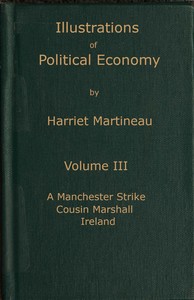
The source record for Illustrations of political economy, Volume 3 (of 9) — Edition Insights measures this digital text at 109,739 words, 7 hr 58 min estimated reading time, and 13 detected text sections.
The text analysis averages about 22.7 words per sentence, while the detected sections provide another way to judge how the source is divided.
Project Gutenberg metadata also associates the work with “Social problems -- Fiction,” connecting these edition facts with the source record’s subject description.
Explore this collection
These alternatives are selected using recorded categories and estimated reading time.
About 479 minutes
Historical Psychological Social Fiction
109,942 recorded words. 1 minutes difference from this book's estimate.
View Gutenberg source #70023About 489 minutes
Historical Psychological Social Fiction
112,383 recorded words. 11 minutes difference from this book's estimate.
View Gutenberg source #72642About 466 minutes
Historical Psychological Social Fiction
107,174 recorded words. 12 minutes difference from this book's estimate.
View Gutenberg source #69789Search stored excerpts and compare books → Choose by your preferences →
Choices use stored catalog measurements. Estimates vary with reading speed. A shared category is a catalog label, not a claim that two books have the same argument or literary quality.
Search reads excerpt text stored with this catalog and links to its associated Gutenberg record. The connection is stored in the site database; this tool does not recheck that every excerpt is word-for-word identical to that external record. Excerpt search does not cover every chapter and does not verify historical publication dates.
Catalog snapshot checked: 2026-09-26. Coverage: 100 public books, 100 available source excerpts.
Calculated from edition completeness, EPUB availability, text structure and catalogue metadata. Not a user rating.
Total of 100 points, scaled to a 2.5-5.0 range. Editions with an empty description or a missing EPUB file are not scored.
Public-domain source text
The source text is kept in the dedicated reader, separate from this catalogue record and its commentary.
Harriet Martineau opens A Manchester Strike with a precise Saturday evening in May, as factory workers pour out onto the banks of the Medlock. The children scatter quickly, but the men linger in knots, a detail that quietly signals the collective tension to come. Martineau’s method is to embed economic argument in domestic and workplace routines: the strike is not announced in a manifesto but emerges from the rhythms of a week’s end. The catalog subjects label this volume “didactic fiction” and “political fiction,” yet the excerpts show a writer who trusts concrete scenes—sunlight on chimneys, a child’s pillow drying in dawn rays—to carry her lessons. The three tales share a structural pattern: a social problem is introduced through a family or neighborhood, then examined through conversation and incident, not treatise.
In A Manchester Strike, Martineau stages the conflict between labor and capital not in a boardroom but at a factory gate on a Saturday evening. The opening chapter, “The Week’s End,” shows workers lingering in groups, the men “in no such haste” to leave. The narrator reports the scene without commentary, letting the reader infer the unease. Later, the chapter titles chart a psychological arc: “Hope declining,” “Hope extinct.” The strike is never explained in abstract terms; instead, Martineau uses the factory setting and the workers’ physical movements to imply the pressures of wages, hours, and solidarity. The excerpts do not reveal whether the strike succeeds or fails, but the language of decline and extinction suggests a grim trajectory. What is visible is Martineau’s craft: she turns an economic event into a narrative of anticipation and loss, anchored in the specific geography of Manchester’s Medlock banks.
Cousin Marshall examines parish charity through the story of Sally, a girl going blind. Martineau renders the dilemma in intimate domestic scenes: Sally’s cousin and her husband debate whether to send her to a Blind Asylum, while Sally herself “fathom[s] the intention” of their hints. The narrator notes that Mrs. Marshall’s sleep is disturbed by “the disclosure she must make in the morning.” The excerpt’s most striking moment comes at dawn, when Sally is found drying her pillow in the first rays of a sunrise she will never see again. Martineau does not lecture on the economics of institutional care; instead, she shows the cost in human terms—the awkwardness of John’s forced praise of the Asylum, the mother’s divided thoughts between relief and sorrow. The chapter titles, such as “What is Charity?” and “Cousin Marshall’s Charities,” promise debate, but the excerpts deliver a portrait of a family making a painful decision under material constraints.
The third tale, Ireland, is structured as a chain of nine chapters, each heading a single noun phrase: “Irish Economy,” “Irish Liabilities,” “Irish Crime,” “Irish Retribution,” and so on. This sequence implies a causal logic—economic conditions lead to liabilities, which lead to crime and retribution. The excerpts do not include the story’s narrative content, but the chapter list itself is a statement of method. Martineau treats Ireland not as a setting for adventure but as a case study in political economy, with each step in the sequence representing a stage of analysis. The catalog subject “Political fiction, English” fits this design, yet the excerpts suggest that Martineau’s fiction is closer to a series of linked arguments than to a conventional plot. Without the full text, it is impossible to know how the characters embody these categories, but the chapter headings offer a clear outline of the author’s explanatory framework.
Readers approaching this volume should expect fiction that argues through incident rather than exposition. Martineau’s characters are often types—the striking worker, the charitable cousin, the Irish peasant—but she gives them specific gestures and domestic spaces that resist mere allegory. The three tales share a formal pattern: each begins with a concrete situation, then expands through conversation and consequence. The catalog labels are accurate, but the excerpts reveal a writer more interested in the texture of daily life than in abstract principles. To read Martineau is to watch political economy unfold in a child’s blindness, a factory gate, or a pillow dried in the sun.
That rainy afternoon, Martineau’s Manchester strike felt less like theory, more like overheard whispering in a kitchen—wages and bread, stubborn pride. Later, restless, I pulled down an old volume, and its pages breathed the same damp air: The curse of gold — Edition Insights turned gold into a kind of weather, pressing on everyone alike. One book simply let me into the next.
A brief reflection can help important ideas stay with you longer.