About 489 minutes
Dusty answer — Key Ideas to Explore
Historical Psychological Social Fiction
112,383 recorded words. 3 minutes difference from this book's estimate.
View Gutenberg source #72642
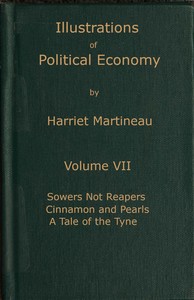
Illustrations of political economy, Volume 7 (of 9) — Story, Setting & Ideas can be approached with a clearer sense of reading commitment from its source measurements: 112,940 words, 8 hr 12 min estimated reading time, and 13 detected text sections.
The text analysis averages about 23.2 words per sentence, while the detected sections provide another way to judge how the source is divided.
Project Gutenberg metadata also associates the work with “Social problems -- Fiction,” connecting these edition facts with the source record’s subject description.
Explore this collection
These alternatives are selected using recorded categories and estimated reading time.
About 489 minutes
Historical Psychological Social Fiction
112,383 recorded words. 3 minutes difference from this book's estimate.
View Gutenberg source #72642About 479 minutes
Historical Psychological Social Fiction
109,942 recorded words. 13 minutes difference from this book's estimate.
View Gutenberg source #70023About 478 minutes
Historical Psychological Social Fiction
109,739 recorded words. 14 minutes difference from this book's estimate.
View Gutenberg source #71169Search stored excerpts and compare books → Choose by your preferences →
Choices use stored catalog measurements. Estimates vary with reading speed. A shared category is a catalog label, not a claim that two books have the same argument or literary quality.
Search reads excerpt text stored with this catalog and links to its associated Gutenberg record. The connection is stored in the site database; this tool does not recheck that every excerpt is word-for-word identical to that external record. Excerpt search does not cover every chapter and does not verify historical publication dates.
Catalog snapshot checked: 2026-09-26. Coverage: 100 public books, 100 available source excerpts.
Calculated from edition completeness, EPUB availability, text structure and catalogue metadata. Not a user rating.
Total of 100 points, scaled to a 2.5-5.0 range. Editions with an empty description or a missing EPUB file are not scored.
Public-domain source text
The source text is kept in the dedicated reader, separate from this catalogue record and its commentary.
Harriet Martineau’s Illustrations of Political Economy, Volume 7 collects three tales—Sowers Not Reapers, Cinnamon and Pearls, and A Tale of the Tyne—each built around a specific economic friction. The author’s preface declares she “take[s] my stand upon Science,” yet the fiction itself works through concrete, often domestic scenes. In Cinnamon and Pearls, a dialogue between Alice and the Cingalese woman Marana exposes how government monopoly on pearl sales prevents Rayo from buying a rice-ground, despite willing buyers and a ready boat. The exchange is brisk, almost Socratic, with Marana’s practical objections—too many fishermen, government control—answered by Alice’s naive faith in mutual benefit. Martineau lets the economic logic emerge from character speech rather than authorial commentary.
Martineau consistently uses dialogue to dramatize abstract principles. In Cinnamon and Pearls, Alice’s questions—“Why cannot they take it in turns to fish?”—are met with Marana’s patient explanations of government restrictions. The conversation moves from a specific case (Rayo’s idleness) to systemic causes (the state’s refusal to let fishermen sell freely). The effect is didactic but not wooden: Marana’s fear of a curse on the charmed shell adds emotional weight to the economic argument. Similarly, in Sowers Not Reapers, the chapter title “Fasters and Feasters” hints at a contrast between those who produce and those who consume, likely dramatized through conflicting voices. Martineau’s characters rarely lecture; they reason from their circumstances.
Material objects carry both economic and symbolic meaning. Marana’s right-handed chank shell is “a little fortune” but also a charm against leprosy; selling it means losing protection. The boat that could take Rayo pearl-fishing remains hypothetical—“the boat may soon be had”—but the government’s refusal to license independent sales makes it useless. Rice-grounds, clothing, and silk dresses appear as concrete markers of well-being. In A Tale of the Tyne, the opening chapter “No News from the Port” suggests that a ship’s arrival or absence determines the characters’ fortunes. Martineau anchors her political economy in things people can touch, trade, or lack.
Each tale builds tension around a delay or a missed opportunity. Sowers Not Reapers moves from “Midsummer Moonlight” to “Too Late” to “The Breaking-up,” implying a harvest that never comes. Cinnamon and Pearls opens with “The Silent Trip” and ends with “Up and Doing,” suggesting a shift from passivity to action. A Tale of the Tyne begins with “No News from the Port” and concludes with “Loyalty Preventives,” a phrase that hints at coercion. Martineau structures her plots around the interval between cause and effect—the time when economic forces work unseen. The reader watches characters wait, hope, and finally face the outcome of policies they cannot control.
Martineau varies her characters’ speech to mark social position. Marana speaks in short, practical sentences: “We want rice, and my husband’s clothing is old.” Alice, the foreigner, uses longer, more theoretical constructions: “But this would be a good thing for everybody.” The narrator’s own voice is restrained, often letting dialogue carry the argument. In the preface, Martineau insists on keeping “myself out of the sight of my readers,” yet the tales are unmistakably shaped by her analytical purpose. The result is a hybrid form—fiction that teaches without pretending to be neutral, where every conversation, every object, and every delay serves a polemical end.
Readers will find that Martineau’s tales reward attention to small details: a shell’s value, a boat’s absence, a harvest that fails. The author’s method is to let economic principles emerge from the texture of daily life, not from abstract lectures. Approach each story as a case study in how policy shapes personal fate, and notice how often the turning point is a conversation, not an event. The three tales together form a triptych of nineteenth-century economic thought, rendered in the voices of those who lived it.
There’s something touching about Martineau’s characters, boxed in by markets they can’t see, waiting on news that decides everything. That same quiet helplessness lingers in The Fellowship of the Frog — Context and Discussion, where ordinary lives get tangled in forces far larger than themselves. I keep thinking how little has changed, really, in what we wait for.
Save your reaction, strongest insight, and memorable passage.