About 353 minutes
Christmas stories — Context and Discussion
Historical Psychological Social Fiction
81,172 recorded words. 4 minutes difference from this book's estimate.
View Gutenberg source #69800
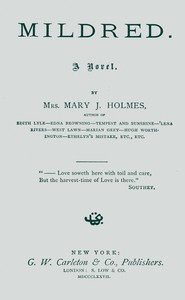
Mildred — Story, Setting & Ideas can be approached with a clearer sense of reading commitment from its source measurements: 80,195 words, 5 hr 49 min estimated reading time, and 25 detected text sections.
The text analysis averages about 23.2 words per sentence, while the detected sections provide another way to judge how the source is divided.
Project Gutenberg metadata also associates the work with “American fiction -- 19th century,” connecting these edition facts with the source record’s subject description.
Explore this collection
These alternatives are selected using recorded categories and estimated reading time.
About 353 minutes
Historical Psychological Social Fiction
81,172 recorded words. 4 minutes difference from this book's estimate.
View Gutenberg source #69800About 340 minutes
Historical Psychological Social Fiction
78,049 recorded words. 9 minutes difference from this book's estimate.
View Gutenberg source #74238About 361 minutes
Historical Psychological Social Fiction
82,942 recorded words. 12 minutes difference from this book's estimate.
View Gutenberg source #73696Search stored excerpts and compare books → Choose by your preferences →
Choices use stored catalog measurements. Estimates vary with reading speed. A shared category is a catalog label, not a claim that two books have the same argument or literary quality.
Search reads excerpt text stored with this catalog and links to its associated Gutenberg record. The connection is stored in the site database; this tool does not recheck that every excerpt is word-for-word identical to that external record. Excerpt search does not cover every chapter and does not verify historical publication dates.
Catalog snapshot checked: 2026-09-26. Coverage: 100 public books, 100 available source excerpts.
Calculated from edition completeness, EPUB availability, text structure and catalogue metadata. Not a user rating.
Total of 100 points, scaled to a 2.5-5.0 range. Editions with an empty description or a missing EPUB file are not scored.
Public-domain source text
The source text is kept in the dedicated reader, separate from this catalogue record and its commentary.
The novel opens with a violent thunderstorm that mirrors Judge Howell's agitation upon reading a letter from Maine. The storm is described with sensory detail—"muttering in deep undertones" and "occasional gleams of lightning"—and the Judge's entrance into his library is marked by a slammed door that "scarcely equalled" the tempest outside. Rachel, the "colored housekeeper," mutters about his mood, hinting at domestic tensions. The letter, postmarked from a remote Maine backwoods, sets the plot in motion, though its contents are not fully revealed in the excerpts.
In Chapter XII, Geraldine and Mr. Thornton conspire to prevent Lawrence from marrying Mildred. Geraldine orchestrates a plan: Mr. Thornton will visit Mildred before she can answer Lawrence's proposal, using her "high temper and foolish pride" against her. He is to hint at shame over her parentage and deliver a letter appealing to her sympathy for Lilian. Geraldine's remark about a servant, "So you think I'd better try Bridget a week or two longer?", is a calculated deception to mislead Lawrence when he enters. Mr. Thornton, less adept at cunning, fears betraying himself and avoids discussing the proposal with his son. This scene showcases the novel's focus on scheming and social maneuvering.
In Chapter XIII, after Lawrence's proposal, Mildred visits Oliver, whom she believes is unaware of romantic love. She thinks, "how much he loses by not knowing what it is to love the way I do." Yet the narrator reveals Oliver's "wild, absorbing love" for Mildred, which he must conceal. He cries in bitterness, asking if the "Good Father" will forgive him for loving her. His caress of her hair—"his long, white fingers moved slowly over her shining hair"—is a habitual gesture that Mildred accepts without suspicion. The contrast between her naive happiness and his hidden anguish is a central tension in the excerpts.
The story is set in Mayfield, with Beechwood as Judge Howell's estate, described with "giant trees of maple and beech." The carriage and "spirited grays" signal wealth, while the hotel and backwoods Maine location suggest a range of social strata. Rachel, the only named Black character in the excerpts, is relegated to a muttered aside, reflecting the period's racial hierarchies. The catalog subject "dime novels" aligns with the melodramatic tone—stormy emotions, secret letters, and love triangles. However, the excerpts show more psychological depth than typical dime fiction, particularly in Oliver's internal conflict.
Readers should note that the excerpts cover only the first thirteen chapters of an eighty-thousand-word novel. The catalog subjects—"adopted children" and "dime novels"—are partially supported: Mildred's adoption is implied but not detailed, and the melodramatic style fits the dime novel category. However, the psychological complexity of Oliver's unrequited love and the intricate scheming of Geraldine suggest a more nuanced work than the label might imply.
Mildred’s world, for all its storms and quiet schemes, still kept a home-hearth glow. That warmth feels distant in the other book, where wage-slavery chills every page. Both measure the cost of wanting, be it a man’s heart or mere bread. I have pondered them together, these two, linked by that aching human hunger. The worship of the golden calf: A story of wage-slavery in Massachusetts — Inside the Classic holds a harder truth, yet shares Mildred’s longing for a place to belong.
Use these questions to collect your thoughts before moving on.