About 377 minutes
Lady Molly of Scotland Yard — Inside the Classic
Science Fiction Utopias
86,693 recorded words. 12 minutes difference from this book's estimate.
View Gutenberg source #72581
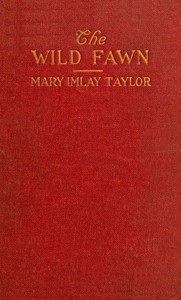
The catalog record for The wild fawn — Inside the Classic provides practical reading context through 83,796 words, 6 hr 5 min estimated reading time, and 32 detected text sections.
The text analysis averages about 12.0 words per sentence, while the detected sections provide another way to judge how the source is divided.
Project Gutenberg metadata also associates the work with “Women dancers -- France -- Fiction,” connecting these edition facts with the source record’s subject description.
Explore this collection
These alternatives are selected using recorded categories and estimated reading time.
About 377 minutes
Science Fiction Utopias
86,693 recorded words. 12 minutes difference from this book's estimate.
View Gutenberg source #72581About 382 minutes
Science Fiction Utopias
87,673 recorded words. 17 minutes difference from this book's estimate.
View Gutenberg source #71450About 348 minutes
Science Fiction Utopias
79,837 recorded words. 17 minutes difference from this book's estimate.
View Gutenberg source #72198Search stored excerpts and compare books → Choose by your preferences →
Choices use stored catalog measurements. Estimates vary with reading speed. A shared category is a catalog label, not a claim that two books have the same argument or literary quality.
Search reads excerpt text stored with this catalog and links to its associated Gutenberg record. The connection is stored in the site database; this tool does not recheck that every excerpt is word-for-word identical to that external record. Excerpt search does not cover every chapter and does not verify historical publication dates.
Catalog snapshot checked: 2026-09-26. Coverage: 100 public books, 100 available source excerpts.
Calculated from edition completeness, EPUB availability, text structure and catalogue metadata. Not a user rating.
Total of 100 points, scaled to a 2.5-5.0 range. Editions with an empty description or a missing EPUB file are not scored.
Public-domain source text
The source text is kept in the dedicated reader, separate from this catalogue record and its commentary.
The novel opens not with the titular 'wild fawn' but with the fretful voice of Mrs. Carter, who is anxious over a gap in her son William's correspondence. Taylor immediately establishes a domestic realism grounded in specific, mundane details—the late postman, a broken jar of strawberry jam, a son's ungrateful wrath—that will serve as a foil to the more exotic presence of Fanchon. The family's dynamics are sketched through brisk, argumentative dialogue: Leigh's teasing of Emily's 'Greek knot' and Mr. Carter's dismissive 'Nonsense!' reveal entrenched hierarchies and simmering resentments. This careful attention to the rhythms of family speech creates a vivid sense of place before the central figure even appears.
Taylor's diction shifts markedly between the Carter family's plain, practical language and the more lyrical descriptions reserved for Fanchon. Mrs. Carter's thoughts are rendered in homely phrases—'the kind that dear Willie always loved'—while Fanchon is introduced through Leigh's romanticized perception: 'her beauty, the subtle charm and mystery of those fawn-like eyes, and her caressing voice.' The contrast is not merely stylistic; it underscores the thematic divide between the provincial, duty-bound Carters and the disruptive, aesthetic world Fanchon represents. Even within the family, speech patterns differentiate characters: Mr. Carter's blunt retorts, Emily's sharpness, and Leigh's poetic effusions all mark their positions in the household's emotional economy.
Dialogue in the excerpts frequently serves as a vehicle for power struggles. Mrs. Carter's fretful questions are met with her husband's deflating 'Nonsense!'; Leigh's defense of Fanchon is dismissed by the family as youthful infatuation. Yet Fanchon herself, though largely absent from the opening chapters, exerts influence through reported speech and gesture: she 'coaxed the boy into still deeper infatuation' and 'always had a kind word for Leigh, a soft pat of the hand.' Taylor uses indirect discourse to convey Fanchon's manipulative charm without granting her direct voice, maintaining an air of mystery. The family's critical commentary—'pitiless criticism'—reveals their anxiety about her foreignness and her hold over William, while Leigh's internal monologue, comparing himself to Sir Lancelot, exposes his naivety.
Taylor's descriptive passages are sparing but pointed. The 'fawn-like eyes' attributed to Fanchon recur as a shorthand for her wild, elusive quality, linking her to the novel's title. Physical details are often filtered through a character's emotional state: William's 'haggard profile and the dark rings under the closed eyes' are seen through his father's horrified gaze, transforming a mundane scene of exhaustion into a symbol of moral decay. Similarly, Leigh's 'handsome, boyish face and the eyes of a girl' marks him as an impressionable youth, while the 'bottle and a glass' beside the sleeping William carries a heavy implication of intemperance. These details are never over-explained; Taylor trusts the reader to connect them to the broader tensions of the narrative.
The excerpts reveal a narrative structure that oscillates between the family's collective perspective and individual focalization. The opening chapter is anchored in Mrs. Carter's anxious consciousness, but later passages shift to Leigh's infatuated viewpoint, creating a layered, sometimes contradictory portrait of Fanchon. Taylor withholds direct access to Fanchon's thoughts, leaving the reader to piece together her character from the reactions she provokes. This technique generates suspense and ambiguity: is Fanchon a victim of provincial prejudice or a calculating interloper? The family's own biases—Mrs. Carter's doting favoritism, Mr. Carter's stern pragmatism, Emily's jealousy—are rendered with enough specificity that no single viewpoint can be trusted as objective. The result is a novel that questions the reliability of domestic judgment itself.
Readers attentive to Taylor's craft will find a novel that operates through implication and contrast rather than overt statement. The spare, functional prose of the Carter household scenes sets off the few moments of lyricism, and the dialogue carries much of the psychological weight. Pay particular attention to who speaks, who is silent, and how descriptions are filtered through a character's biases—these choices shape the novel's central ambiguity about Fanchon's true nature.
In The Wild Fawn, Fanchon’s quiet strangeness unsettles a household — not through grand gestures, but through the weight of what she doesn’t say. That same reticence hums beneath Henry goes prehistoric — A Reader’s Guide, where an old silence becomes a gentle beginning. Both remind me that change arrives like a soft footfall, often unnoticed until the floor remembers.
Save your reaction, strongest insight, and memorable passage.