About 382 minutes
My heart's in the Highlands — Story, Setting & Ideas
Science Fiction Utopias
87,673 recorded words. 5 minutes difference from this book's estimate.
View Gutenberg source #71450
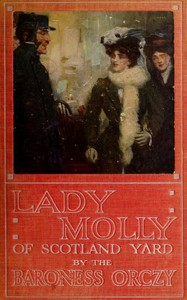
The source record for Lady Molly of Scotland Yard — Inside the Classic measures this digital text at 86,693 words, 6 hr 17 min estimated reading time, and 9 detected text sections.
The text analysis averages about 20.0 words per sentence, while the detected sections provide another way to judge how the source is divided.
Project Gutenberg metadata also associates the work with “Detective and mystery stories,” connecting these edition facts with the source record’s subject description.
Explore this collection
These alternatives are selected using recorded categories and estimated reading time.
About 382 minutes
Science Fiction Utopias
87,673 recorded words. 5 minutes difference from this book's estimate.
View Gutenberg source #71450About 365 minutes
Science Fiction Utopias
83,796 recorded words. 12 minutes difference from this book's estimate.
View Gutenberg source #72891About 403 minutes
Science Fiction Utopias
92,568 recorded words. 26 minutes difference from this book's estimate.
View Gutenberg source #72356Search stored excerpts and compare books → Choose by your preferences →
Choices use stored catalog measurements. Estimates vary with reading speed. A shared category is a catalog label, not a claim that two books have the same argument or literary quality.
Search reads excerpt text stored with this catalog and links to its associated Gutenberg record. The connection is stored in the site database; this tool does not recheck that every excerpt is word-for-word identical to that external record. Excerpt search does not cover every chapter and does not verify historical publication dates.
Catalog snapshot checked: 2026-09-26. Coverage: 100 public books, 100 available source excerpts.
Calculated from edition completeness, EPUB availability, text structure and catalogue metadata. Not a user rating.
Total of 100 points, scaled to a 2.5-5.0 range. Editions with an empty description or a missing EPUB file are not scored.
Public-domain source text
The source text is kept in the dedicated reader, separate from this catalogue record and its commentary.
The first story, “The Ninescore Mystery,” establishes a pattern that runs through the collection: the narrator, a subordinate officer in the Female Department, introduces Lady Molly as a figure of mystery and skill. The narrator’s opening remarks—that some say Lady Molly is “the daughter of a duke” while others claim she was “born in the gutter”—immediately signal that the stories will be as much about the protagonist’s enigmatic background as about the crimes she solves. This framing device, maintained throughout, gives the reader a consistent point of view while keeping Lady Molly herself at a slight remove.
The unnamed narrator is not merely a passive observer; she is an active participant in the investigations, often providing the reader with details that Lady Molly herself withholds. In “The Ninescore Mystery,” the narrator describes the quarrel between Major Ceely and Mr. Smethick, noting that the witnesses “tacitly agreed to say nothing at all about it at the inquest.” This decision to suppress information, made by the narrator and her colleagues, creates a tension between the official record and the private knowledge of the female detectives. The narrator’s voice is colloquial and direct, using phrases like “wish I may die” to underscore her loyalty. This structural choice—having a subordinate tell the story—allows Orczy to reveal Lady Molly’s methods gradually, as the narrator herself learns them.
The stories frequently shift between the domestic settings where crimes occur and the official spaces of police stations and inquests. In “The Ninescore Mystery,” the action moves from the “Black Swan” inn to the Bishopthorpe police station, where Superintendent Etty’s private room becomes a stage for interrogation. The description of Mrs. Haggett—her “shabby-looking black” coat and skirt, her “holes in her shoes and in her stockings”—is given in the police station, not in her home. This juxtaposition of the domestic (the servant’s worn clothing) with the official (the superintendent’s office) highlights the way the female detectives must navigate both spheres. Lady Molly herself moves easily between them, using her aristocratic bearing in one setting and her intuition in another.
Clothing and physical appearance are repeatedly used as clues or misdirections. In the excerpt, Mrs. Haggett’s “very red and very coarse-looking hands” and her “furtive expression” are described in detail, suggesting that the narrator reads character through appearance. The illustrations listed in the contents—such as “The woman gave a shriek which unmistakably was one of fear” and “She was ashy-pale, staring straight before her”—indicate that visual cues are central to the storytelling. The narrator’s attention to Mrs. Haggett’s “half unsewn” sleeve and “loops” of braid implies that disorder in dress may mirror disorder in character. This focus on the material details of clothing, from the “Irish-Tweed Coat” of a later story to the “big hat” of another, suggests that Orczy uses fashion and fabric as a kind of forensic evidence.
The stories often accelerate their pace through the use of modern transportation. In “The Ninescore Mystery,” the narrator notes that “we had the use of a motor” and that “in less than ten minutes we were bowling along at express speed towards Bishopthorpe.” This rapid movement between locations—from the inn to the police station, from the crime scene to the inquest—creates a sense of urgency and efficiency. The motor car is not merely a convenience; it is a tool that allows Lady Molly to arrive before the male authorities have fully processed the situation. The phrase “bowling along at express speed” suggests both speed and control, mirroring Lady Molly’s own mental agility. This recurring image of swift travel underscores the collection’s emphasis on action and resolution.
The excerpts provided cover only the opening of the first story and the end matter of the book. We cannot determine from these passages how the later stories develop Lady Molly’s character or whether the narrator’s promise of secrecy is ever broken. The list of contents suggests a variety of settings—from “A Castle in Brittany” to “A Christmas Tragedy”—but the excerpts do not reveal how these settings are used. Similarly, the illustrations mentioned in the contents hint at dramatic moments, but we cannot confirm their relationship to the text. Readers should approach the collection as a series of self-contained mysteries, each potentially offering new insights into Lady Molly’s methods and the narrator’s perspective.
Readers of Lady Molly of Scotland Yard will find that the pleasure of these stories lies not only in the solutions to the crimes but in the way Orczy builds each narrative around the relationship between the two women. Pay attention to the details the narrator chooses to include—the condition of a suspect’s clothing, the speed of a motor car, the silence of a witness—as these are the threads that Lady Molly will later pull to unravel the mystery.
I finished that Lady Molly note and couldn’t stop thinking about how clothes carry whole stories—the way a collar or a torn sleeve becomes more telling than any confession. It reminded me of another quiet book where similar details linger just beneath the surface, almost waiting to be noticed at your own pace. Mr. Jervis, Vol. 2 (of 3) — Reading Notes held that same gentle patience for me, like a long exhale between chapters.
Answer a few questions and save a private reflection on this device.