About 456 minutes
The pioneer — Reading Companion
Science Fiction Utopias
104,821 recorded words. 1 minutes difference from this book's estimate.
View Gutenberg source #73040
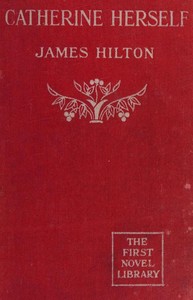
The source record for Catherine herself — Inside the Classic measures this digital text at 104,599 words, 7 hr 35 min estimated reading time, and 26 detected text sections.
The text analysis averages about 13.6 words per sentence, while the detected sections provide another way to judge how the source is divided.
Project Gutenberg metadata also associates the work with “Bildungsromans,” connecting these edition facts with the source record’s subject description.
Explore this collection
These alternatives are selected using recorded categories and estimated reading time.
About 456 minutes
Science Fiction Utopias
104,821 recorded words. 1 minutes difference from this book's estimate.
View Gutenberg source #73040About 416 minutes
Science Fiction Utopias
95,675 recorded words. 39 minutes difference from this book's estimate.
View Gutenberg source #75281About 410 minutes
Science Fiction Utopias
94,210 recorded words. 45 minutes difference from this book's estimate.
View Gutenberg source #69435Search stored excerpts and compare books → Choose by your preferences →
Choices use stored catalog measurements. Estimates vary with reading speed. A shared category is a catalog label, not a claim that two books have the same argument or literary quality.
Search reads excerpt text stored with this catalog and links to its associated Gutenberg record. The connection is stored in the site database; this tool does not recheck that every excerpt is word-for-word identical to that external record. Excerpt search does not cover every chapter and does not verify historical publication dates.
Catalog snapshot checked: 2026-09-26. Coverage: 100 public books, 100 available source excerpts.
Calculated from edition completeness, EPUB availability, text structure and catalogue metadata. Not a user rating.
Total of 100 points, scaled to a 2.5-5.0 range. Editions with an empty description or a missing EPUB file are not scored.
Public-domain source text
The source text is kept in the dedicated reader, separate from this catalogue record and its commentary.
From its first chapter, Catherine herself announces a distinctive authorial voice through the child Catherine's fragmentary, sensory perceptions: "Day is white, Night is black, but sometimes it is half-white and half-black." The narrative filters the world through a young mind that registers sounds—the father's "Hr-rooch—flop" as he removes boots, the "Chug-chug" of the pumping-engine—and visual details like the five knobs on a brass bed rail. This technique, sustained across the novel, establishes Catherine's consciousness as the primary lens, blending innocence with acute observation.
The opening prelude immerses readers in Catherine's early world through disjointed impressions rather than linear storytelling. Hilton renders the father's morning routine as onomatopoeic sound: "Ooflip-oorooflip" for eating porridge, and the mother's call, "John: come on! Past eight." The child's understanding of religion is similarly concrete: heaven is "full of white tiles and marble-slabs, like a fish-shop," while hell would be "far too hot for you even if you were feeling cold." Such details reveal how Catherine constructs meaning from limited experience, a pattern that persists as she grows. The narrative voice remains tethered to her perspective, avoiding adult explanation. This technique creates an intimate, sometimes unsettling closeness to a mind still learning to interpret the world.
Music becomes a central vehicle for Catherine's inner life, and Hilton renders her relationship to it with precision. During a piano lesson, she plays Chopin's Etude and reflects: "I'm in love with Something . Some Thing! Very deeply, very passionately, I am. And I don't know what it is." The passage captures her yearning for an abstract ideal, which she senses in the music but cannot yet attach to a person. Her teacher, Verreker, speaks in clipped, practical sentences—"you've come to a point at which my lessons are no longer worth three guineas each to you"—contrasting sharply with her emotional intensity. Hilton uses this contrast to highlight Catherine's isolation: her most profound experiences occur internally, while those around her remain preoccupied with mundane concerns. The dialogue between them, with Catherine's repeated nods, underscores her inarticulateness in the face of feeling.
Hilton crafts dialogue that reveals character dynamics through rhythm and word choice. In the lesson scene, Verreker's hesitant, qualifying speech—"you've not done badly. In fact, you've—you've improved—er—quite—er—beyond my expectations"—conveys his awkwardness with praise. Catherine's responses are minimal, often single words or nods, suggesting her emotional reserve. Later, in the chapter "Loneliness," the narrative summarizes her loss of companionship with the Trant family, noting specific details: "Mr. Trant's bluff hooliganism (which she detested), and Helen's smile, aloof yet full of serene understanding." The parenthetical "which she detested" is a rare direct judgment, hinting at Catherine's growing critical awareness. These dialogic and descriptive choices build a portrait of a young woman navigating relationships that are often unsatisfying, leaving her to seek fulfillment in music and solitary reflection.
The novel's chapter titles—"Prelude," "Nocturne," "Crescendo," "Accelerando," "Allegro con Fuoco"—borrow musical terminology, framing Catherine's life as a composition. This structural choice aligns with the authorial emphasis on her musical identity. The excerpts show a progression from the child's fragmented perceptions to the young woman's more coherent, though still turbulent, inner monologue. The chapter "Loneliness" follows directly after "The Second Trant Episode," suggesting a causal link between social rupture and emotional state. Hilton does not explain these connections; instead, he lets the sequence of titled sections imply a narrative arc. Readers attentive to these structural cues will notice how the novel's form mirrors Catherine's development: from isolated impressions to sustained reflection, from dependence on others to a fraught self-reliance.
Readers approaching Catherine herself should attend to the interplay between what Catherine perceives and what she says aloud. Hilton's prose often withholds direct commentary, leaving the reader to infer meaning from juxtaposed scenes and recurring motifs—the brass knobs, the Chopin Etude, the word "Something" capitalized. This restraint invites a careful, patient reading that rewards attention to the novel's linguistic and structural patterns.
I finished the Hilton book and kept thinking about how Catherine’s music lingers past the final page, like a note held too long. That same quiet ache stayed with me after The boy who brought Christmas — Inside the Classic—both stories feel less like plots and more like someone remembering warm air. I just set mine down gently.
Build a private reading journal entry for this title.