About 747 minutes
The story of Don Miff — Reading Notes
Science Fiction Utopias
171,732 recorded words. 55 minutes difference from this book's estimate.
View Gutenberg source #73601
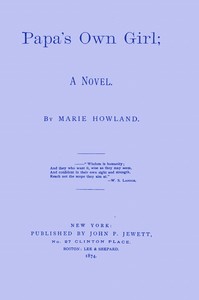
Before opening Papa's own girl: A novel — Reading Companion, the edition data offers a quick orientation: 159,032 words, 11 hr 32 min estimated reading time, and 46 detected text sections.
The text analysis averages about 18.4 words per sentence, while the detected sections provide another way to judge how the source is divided.
Project Gutenberg metadata also associates the work with “Fantasy fiction,” connecting these edition facts with the source record’s subject description.
Explore this collection
These alternatives are selected using recorded categories and estimated reading time.
About 747 minutes
Science Fiction Utopias
171,732 recorded words. 55 minutes difference from this book's estimate.
View Gutenberg source #73601About 456 minutes
Science Fiction Utopias
104,821 recorded words. 236 minutes difference from this book's estimate.
View Gutenberg source #73040About 455 minutes
Science Fiction Utopias
104,599 recorded words. 237 minutes difference from this book's estimate.
View Gutenberg source #71786Search stored excerpts and compare books → Choose by your preferences →
Choices use stored catalog measurements. Estimates vary with reading speed. A shared category is a catalog label, not a claim that two books have the same argument or literary quality.
Search reads excerpt text stored with this catalog and links to its associated Gutenberg record. The connection is stored in the site database; this tool does not recheck that every excerpt is word-for-word identical to that external record. Excerpt search does not cover every chapter and does not verify historical publication dates.
Catalog snapshot checked: 2026-09-26. Coverage: 100 public books, 100 available source excerpts.
Calculated from edition completeness, EPUB availability, text structure and catalogue metadata. Not a user rating.
Total of 100 points, scaled to a 2.5-5.0 range. Editions with an empty description or a missing EPUB file are not scored.
Public-domain source text
The source text is kept in the dedicated reader, separate from this catalogue record and its commentary.
Marie Howland's Papa's Own Girl (1874) opens with a seven-year-old narrator recalling the arrival of 'mysterious little red-faced sisters'—a vivid, childlike image that sets the novel's tone of intimate observation. The story quickly centers on Clara Forest, whose return to her father's house after leaving her husband sparks a family crisis. Howland's dialogue reveals character through contrasting voices: the doctor's immediate, unhesitating support ('You need not justify yourself to me'), his wife's horror at a woman leaving 'such a model husband,' and the sisters' whispered commentary ('It's papa's own girl, you see'). These exchanges establish a domestic battleground where affection and principle collide.
Dr. Forest's response to Clara's return is the novel's emotional anchor. He does not ask for explanations, declaring, 'Do I not know that it is natural for a wife to stick to her husband through thick and thin? You are a warm-hearted, honest girl, and the fact that you have left him, is enough for me.' This logic—trusting character over convention—defines his parenting. Howland contrasts his patience with Mrs. Forest's reproaches, which stem from 'horror of a woman who has the audacity to leave her husband.' The doctor's method of discipline is also distinctive: he never scolds but shows 'his own grief that she had been guided by her lower, instead of her higher motives.' This approach, coupled with his belief that 'yielding to base feelings made the face ugly,' reveals a moral system rooted in aesthetics and empathy rather than punishment.
The Forest household is populated by distinct female voices. Leila's whisper—'It's papa's own girl, you see, and of course she can't do anything wrong'—carries a mix of irony and resentment, while Linnie's practical kindness ('Dinah shall make you a cup of tea') offers immediate comfort. Mrs. Forest's stricken cry—'It is dreadful! but God knows best why afflictions are sent upon me'—reveals a piety that blames the sufferer. Howland uses these contrasting reactions to map the family's emotional landscape. The doctor's intervention—'You offend me beyond endurance'—shows him as a buffer against his wife's 'injustice.' Notably, the narrator observes that Clara had always gone to her father 'instead of her mother' with troubles, a pattern that shapes the novel's central relationship.
Howland's dialogue does not merely advance plot; it enacts ethical debate. When Clara whispers, 'I have no husband. I have left Albert Delano forever!', the statement is both confession and declaration. The doctor's response—'I know he has acted like a brute'—is an immediate judgment based on faith in Clara's character. This technique recurs throughout the excerpt: characters state positions, and the doctor's authority settles disputes. The narrator's aside that 'there could be no greater harm done by talking of her griefs than by silently brooding over them' reflects Howland's interest in emotional honesty. The doctor allows Clara to 'talk on until far into the night,' treating speech as therapy. This preference for open discussion over repression aligns with the novel's reformist themes.
The third-person narrator frequently interjects with generalizations that guide reader interpretation. Statements like 'She was always as sure of it as that the day will follow the night' elevate the doctor's reliability to a natural law. The narrator also explains the doctor's parenting philosophy in abstract terms: 'Another principle was continually impressed upon his children by the doctor: that yielding to base feelings made the face ugly.' These editorial comments create a moral framework that is both didactic and intimate. Howland's prose blends concrete domestic details—'awful black rings around her eyes,' 'a warm bath ready'—with broader reflections on human nature. This combination of the particular and the universal gives the novel its distinctive texture, grounding utopian ideals in everyday family life.
Readers attentive to Howland's craft will notice how she uses the Forest household as a microcosm for larger social questions. The doctor's unwavering support for Clara challenges contemporary norms about marriage and female autonomy, while the sisters' varied responses hint at the spectrum of women's perspectives in the 1870s. The novel's title, Papa's Own Girl, signals both affection and a critique of paternal authority—a tension that drives the narrative forward.
Rereading Papa’s Own Girl, I kept returning to that quiet ache between Howland’s father and daughter—how love and authority braid so tightly. It reminded me of another voice, older and stranger, wrestling the same tangle. There’s a gentleness in Meleager — Key Ideas to Explore that felt like finding an old letter in a drawer, folded but still warm.
Save your reaction, strongest insight, and memorable passage.