
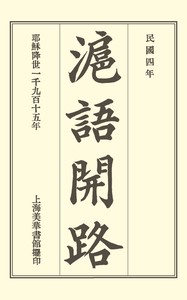
滬語開路 = Conversational Exercises in the Shanghai Dialect by Crofoot and Rawlinson
Okay, let's be clear: this is not a novel. There's no main character or plot twist in the traditional sense. 'Conversational Exercises in the Shanghai Dialect' is a language textbook, published in 1913. Its 'story' is the one it tries to prepare its readers for. The book is a series of scripted dialogues, designed to teach Westerners (likely missionaries and businessmen) how to speak Shanghainese for everyday situations.
The Story
The 'plot' unfolds through these conversations. You follow along as a foreigner learns how to hail a rickshaw, rent a house, visit a doctor, and complain to the police. One dialogue might be about hiring a cook, the next about bargaining for fabric, and another about explaining Christian concepts. There's no overarching narrative, just a steady march through the practical (and often privileged) needs of an expatriate living in the International Settlement of old Shanghai. The drama is all in the subtext—the unspoken rules and social hierarchies you have to navigate just to get through the day.
Why You Should Read It
This is where it gets fascinating. Reading this book today feels like eavesdropping on history. The language is stiff and textbook-y, but the scenarios are raw slices of colonial life. You see what the authors thought was important to learn: how to manage servants, how to assert authority, how to move through the city as a person of assumed status. It's unintentionally revealing. You're not just learning phrases; you're seeing a specific, filtered perspective on Shanghai society. It's a mirror held up to the concerns and assumptions of the foreign community at that time. For anyone interested in Shanghai's history, colonial studies, or even just how language learning reveals cultural power, this is a goldmine.
Final Verdict
This isn't for everyone. If you're looking for a page-turning story, look elsewhere. But if you're a history nerd, a language geek, or someone fascinated by Shanghai's past, this little book is a unique treasure. It's perfect for readers who love primary sources that show history from a ground-level, practical angle. Think of it as an archaeological dig in book form—you have to brush away the dusty grammar to find the real story underneath. A totally unexpected and compelling read for the right curious mind.
This historical work is free of copyright protections. Feel free to use it for personal or commercial purposes.
Ava Scott
1 year agoFive stars!
Ashley Smith
1 year agoI started reading out of curiosity and the plot twists are genuinely surprising. A valuable addition to my collection.
Kimberly Rodriguez
8 months agoI was skeptical about the depth of this book at first, but the breakdown of complex theories into digestible segments is masterfully done. Thanks for making such a high-quality version available.