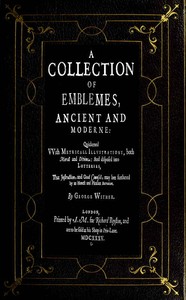
A Collection of Emblemes, Ancient and Moderne by George Wither
Let's be clear from the start: if you're looking for a page-turning story, this isn't it. George Wither's A Collection of Emblemes is something else entirely. Published in 1635, it's a massive book built around a simple, repetitive idea. Wither took a series of symbolic images—a lion, a burning candle, a ship in a storm—and used each one as a springboard for a poem. Each 'embleme' gets a picture, a short motto (like 'I burn to give light'), and then several pages of Wither's verse unpacking the moral lesson.
The Story
There's no narrative in the traditional sense. The 'story' is the journey of a soul being advised. Wither acts as a guide, using these pictures to talk about virtue, vice, love, death, ambition, and faith. One emblem might warn against pride using the image of a peacock. The next might encourage patience with a picture of an ox at the plough. He's trying to teach his readers how to think and how to live, using these visuals as memorable anchors for his ideas. It's a textbook for the conscience, written in rhyme.
Why You Should Read It
What grabbed me was the voice. Wither isn't some distant, dusty philosopher. He's opinionated, earnest, and sometimes funny. You can hear him trying to connect, to make these old symbols matter to the baker, the farmer, or the merchant reading his book. It's a direct line to 17th-century popular thought. The emblems themselves are fascinating—a visual language everyone was supposed to understand. Reading it feels like decoding a secret code about how people saw their world. You start to see how a simple image could carry a whole sermon's worth of meaning.
Final Verdict
This book is a niche treasure. It's perfect for history buffs who want to get beyond kings and battles and into the everyday mindset of the past. It's great for poetry lovers curious about the strange, didactic verse of the era. And it's a must for anyone interested in art history, symbolism, or the simple question of how people have always tried to be better. It's not a cover-to-cover read; it's a book to dip into, to ponder one emblem at a time. If you're open to something completely different—a conversation with a passionate, long-gone guide—you'll find it surprisingly rewarding.
This title is part of the public domain archive. Feel free to use it for personal or commercial purposes.