
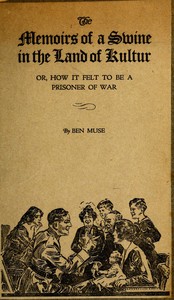
The Memoirs of a Swine in the Land of Kultur; or, How it Felt to be a Prisoner…
I picked up this book expecting a grim, straightforward account of survival. What I found was something much richer and more surprising. Benjamin Muse’s voice is clear, direct, and often wryly funny, which makes his story of captivity feel incredibly immediate.
The Story
In 1918, Benjamin Muse was a young American soldier fighting in France. During a German offensive, his unit was overrun, and he was taken prisoner. The book follows his journey from the front lines into the German prison camp system. This isn't a tale of daring escapes (though there's plenty of tension). It's about the daily grind of captivity. Muse describes the dehumanizing process of being processed, the long marches under guard, and finally, life inside the camps. He writes about the hunger, the boredom, the arbitrary cruelty of some guards, and the unexpected kindness of others. He shows us how the prisoners coped—through black market trading, putting on theatrical shows, and forming tight-knit communities. The 'Land of Kultur' in the title becomes a darkly ironic backdrop for this experience of being treated as less than human.
Why You Should Read It
This book grabbed me because it’s about the human spirit in a weird, suspended state. Muse isn't a classic hero; he's just a guy trying to get through the day. His observations are sharp. He notices the petty power trips of the guards, the dark humor that kept men sane, and the sheer strangeness of being a captive in a country that saw itself as culturally superior. The title itself is a masterpiece of sarcasm, and that tone carries through. He doesn't ask for your pity. Instead, he invites you to see the absurdity and the resilience. It makes the history feel personal, not like dates in a textbook. You finish the book not just knowing what happened, but feeling what it might have been like.
Final Verdict
Perfect for history buffs who are tired of the general's-eye-view of war, and for anyone who loves a memoir with a strong, unique voice. If you enjoyed the personal perspectives in books like All Quiet on the Western Front but want to see the conflict from a completely different angle—behind the wire—this is your next read. It’s a short, powerful reminder that war isn't just about the fighting; it's also about the waiting, the enduring, and the small acts of dignity that defy a system built to strip it away.
This title is part of the public domain archive. Distribute this work to help spread literacy.
William Smith
2 years agoIt took me a while to process the complex ideas here, but the cross-referencing of different chapters makes it a great study tool. It’s a comprehensive resource that doesn't feel bloated.
Thomas Jackson
2 years agoIt took me a while to process the complex ideas here, but the chapter on advanced strategies offers insights I haven't seen elsewhere. I am looking forward to the author's next publication.
Emily Miller
1 year agoI stumbled upon this title and the content flows smoothly from one chapter to the next. I will read more from this author.
Michelle Nguyen
1 year agoVery interesting perspective.









Karen White
2 months agoHaving followed this topic for years, I can say that the transition between theoretical knowledge and practical application is seamless. Highly recommended for those seeking credible information.