
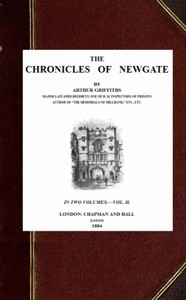
The Chronicles of Newgate, vol. 2/2 by Arthur Griffiths
Arthur Griffiths had a front-row seat to one of history's most notorious institutions. As a former inspector of prisons, he writes about Newgate not just as a historian, but as someone who knew its corridors and its secrets. This second volume continues his detailed account, painting a vivid picture of an era when punishment was a public spectacle and prison was often a death sentence in itself.
The Story
This isn't a novel with a single plot. Instead, Griffiths structures his chronicle like a series of case files and social observations. He walks us through the prison's daily routine—the filth, the corruption among jailers, the stark separation between debtors and felons. We follow famous inmates on their final journeys to the gallows, and meet lesser-known figures whose stories are just as compelling. The 'narrative' tension comes from the clash between the old, brutal system and the growing movement for reform. You see the public's bloodthirsty appetite for executions, and the slow, difficult fight by figures like John Howard to introduce basic humanity. It's the story of a society figuring out what justice means, with Newgate at its cruel heart.
Why You Should Read It
What makes this book stand out is Griffiths' voice. He's not a dry academic; he's a storyteller with insider knowledge. He has strong opinions, and he doesn't shy away from the grim details, but he also reveals flashes of dark humor and unexpected humanity. You get the sense he's telling you these stories over a drink, pointing out the hypocrisies and the tragedies. Reading it, you're not just learning facts—you're feeling the chill of a condemned cell and the chaos of execution day. It connects dots between history, true crime, and human nature in a way that feels surprisingly modern.
Final Verdict
Perfect for history buffs who like their facts served with personality, or true-crime fans looking for the original, real-life stories. It's also great for anyone who enjoys narrative nonfiction that transports you completely to another time. A word of caution: it doesn't gloss over the violence and suffering of the period. But if you're ready for an unflinching, fascinating, and conversation-starting look at the past, Griffiths' chronicle is a unique and gripping read. You'll look at our modern justice system very differently after turning the last page.
This text is dedicated to the public domain. You can copy, modify, and distribute it freely.
Patricia Harris
1 year agoThe digital formatting makes it very easy to navigate.
William Martin
11 months agoHaving explored several resources on this, I find that the objective evaluation of the pros and cons is very refreshing. This has become my go-to guide for this specific topic.
George Moore
6 months agoI was particularly interested in the case studies mentioned here, the bibliography and references suggest a high level of research and authority. The price-to-value ratio here is simply unbeatable.
Kenneth Garcia
1 year agoFinally a version with clear text and no errors.





Jessica White
3 weeks agoComparing this to other titles in the same genre, the transition between theoretical knowledge and practical application is seamless. It cleared up a lot of the confusion I had previously.