
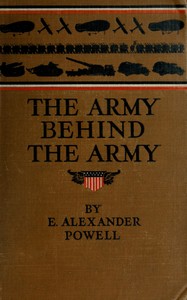
The army behind the army by E. Alexander Powell
When we picture World War I, we often imagine muddy trenches, barbed wire, and soldiers going 'over the top.' E. Alexander Powell shows us the other, equally critical picture: the staggering effort of building an entire American logistical network in France from the ground up. This is the story of the Service of Supply, the literal backbone of the fighting force.
The Story
Powell, a war correspondent, takes us on a tour of the American military's greatest non-combat achievement. The book follows the monumental task faced after the U.S. entered the war in 1917. France's ports and railways were overwhelmed. There was no system to receive two million American troops and all their equipment. The narrative shows how the Army's support services tackled this. They built massive new dock facilities at French ports like Bordeaux and Saint-Nazaire. They constructed entire cities of warehouses, hospitals, and repair shops. Perhaps most impressively, they built, rebuilt, and operated thousands of miles of railroads to move men and supplies to the front. Powell makes us witnesses to this frantic, creative, and Herculean effort, arguing that without this 'army behind the army,' the soldiers at the front could never have fought.
Why You Should Read It
This book is a masterclass in making the 'boring' stuff absolutely fascinating. Powell has a keen eye for the human detail within the giant operation. You'll meet the engineers solving problems on the fly and the railroad men running trains under shellfire. It shifts your perspective from the drama of the battlefield to the drama of creation and supply. You gain a deep appreciation for the sheer scale of modern war, which depends entirely on movement and supply chains. It’s a powerful reminder that history isn't just made by those who fire the shots, but by those who make sure the shooters have bullets, bread, and a way to get there.
Final Verdict
Perfect for history buffs who want to see beyond the battle maps, or for anyone who enjoys stories of large-scale organization and real-world ingenuity. If you've ever been curious about how things actually work in a massive undertaking, this is your book. It’s not a dry military manual; it’s a firsthand account filled with urgency and admiration for the people who did the impossible. Just be prepared—you'll never look at a railroad, a port, or a warehouse the same way again.
You are viewing a work that belongs to the global public domain. You are welcome to share this with anyone.
Amanda Williams
3 months agoRead this on my tablet, looks great.
Linda Clark
1 year agoI started reading out of curiosity and the depth of research presented here is truly commendable. Highly recommended.









Mark Hernandez
1 year agoHonestly, the pacing is just right, keeping you engaged. Thanks for sharing this review.