
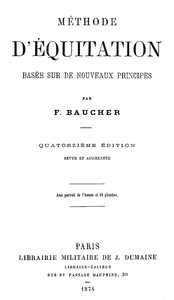
Méthode d'équitation basée sur de nouveaux principes by François Baucher
Published in 1842, François Baucher's book is less of a story in the traditional sense and more of a detailed manifesto. It systematically lays out his radical new approach to training horses, step by step. He throws out the old playbook, which relied on dominance and physical force to make a horse submit. Instead, Baucher introduces concepts like 'the descent of the hand' and 'ramener'—asking for the horse to soften and bring its head in, creating a light, responsive connection. He breaks movement down into isolated parts ('the means') to teach the horse without confusion or fear. The core of his method is that a horse must be mentally 'supple' and calm before it can be physically balanced and collected. It's a complete 180 from the harsh, drill-based training of his time.
Why You Should Read It
Even if you've never sat on a horse, this book is a gripping study of a revolutionary mind. Baucher writes with absolute conviction. You can feel his passion and his frustration with the 'old ways.' Reading it, you're pulled into his world of precise movements and philosophical arguments about partnership versus domination. The drama isn't in fictional plot twists, but in the sheer audacity of his ideas. It makes you think about how we communicate with any animal, or even each other. Is it better to force compliance or to seek understanding? Baucher chose the latter, and he argued for it with a clarity that still feels fresh.
Final Verdict
This is a must-read for horse lovers and trainers, of course. They'll geek out over the technical details that still influence modern dressage. But it's also perfect for anyone interested in the history of ideas, sports science, or just a really good underdog story. Baucher was the ultimate disruptor, and his book is the blueprint. Be prepared for dense, technical sections—it's a manual, after all—but push through. The voice of a true believer, arguing for kindness and intelligence over force, shines through on every page.
This publication is available for unrestricted use. It is available for public use and education.